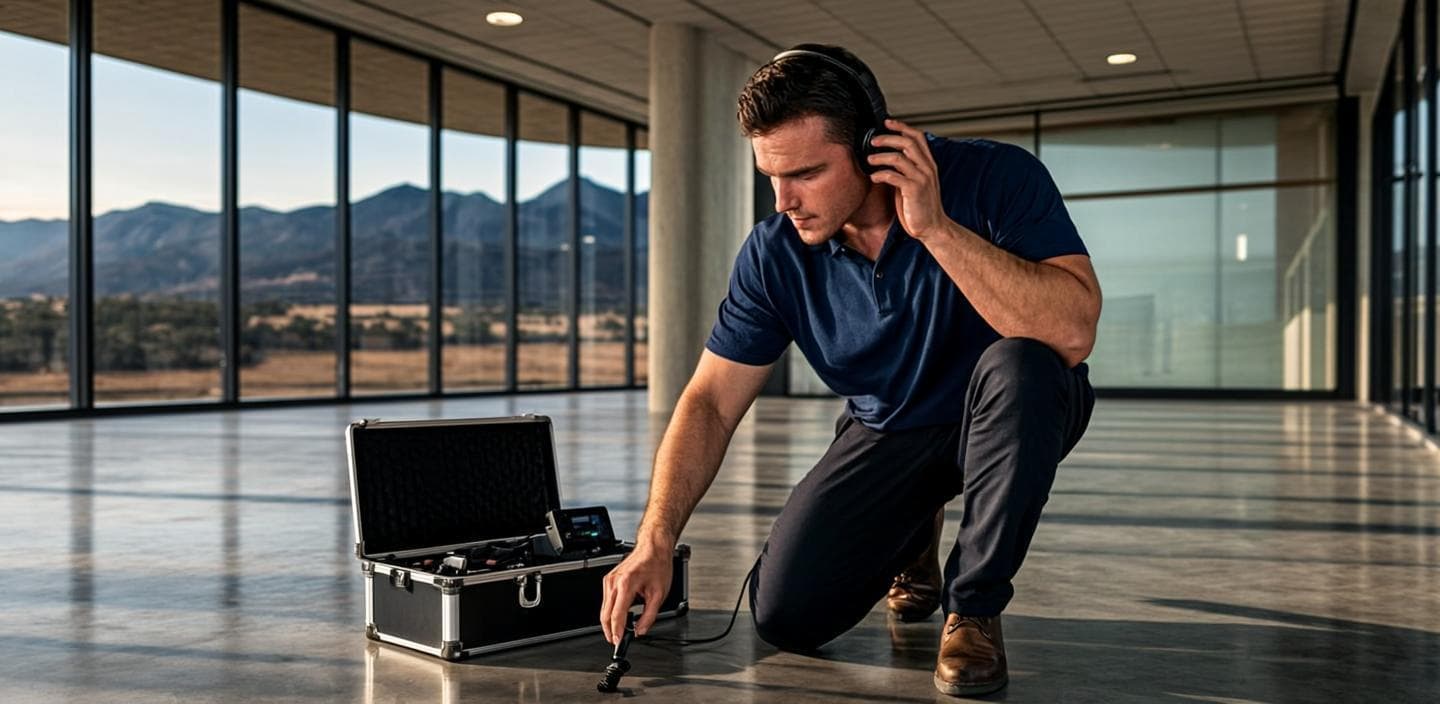
A tenant calling about a ceiling stain, a master meter that jumped with no change in operations, a musty smell that won't leave a suite, a dining room you can't afford to close — those are the moments commercial property owners and managers bring us in. We locate leaks in slab systems, domestic water lines and drain lines with acoustic, thermal and pressure testing — scheduled around your business hours, isolated suite by suite on shared meters, and documented in written reports your insurer and your board will actually accept.
Restaurants don't stop for diagnostics and offices can't close a suite for a guess. We book after-hours, pre-open and weekend windows, and most locating work is done without interrupting water service to your operation.
Documentation That Moves Claims
Commercial water losses live or die on paperwork. Every visit produces a written report with photos, pressure readings, the located leak position and the repair scope — formatted for insurance adjusters, property managers and association boards.
Quiet, Non-Invasive Locating
Acoustic amplifiers, thermal imaging and tracer methods find the leak from the surface — no exploratory jackhammering through a retail floor mid-week. Your customers, tenants and inventory stay dry and undisturbed.
Single Suite or Whole Campus
From one restaurant in Old Town to a multi-tenant office park on a single master meter, we isolate leaks by riser, wing and suite — and coordinate access, scheduling and reporting with owners, managers and tenant contacts.
The Commercial Specialist
What Is Commercial Leak Detection?
Commercial leak detection is the same diagnostic discipline we bring to Temecula homes — acoustic, thermal and pressure testing to find hidden water without demolition — scaled to the way commercial buildings are actually built and operated. That means longer pipe runs from bigger meters, supply risers climbing through multiple stories, shared domestic lines feeding several tenants at once, and drain laterals that cross property lines under common areas. It also means the diagnostic questions are different: not just "where is the leak?" but "whose suite is it in?", "whose policy covers it?" and "how do we fix it without shutting the building down?".
The stakes are different too. Industry figures put the average commercial water damage loss near $89,000 per claim, and water damage consistently ranks among the most frequent commercial property claims — well over half by some insurer counts. A leak in a restaurant wall threatens a health-department inspection, not just drywall. A leak under a retail floor is a slip-and-fall file waiting to happen. And every week an unexplained meter spike goes undiagnosed, you're paying for water nobody asked for — often at commercial rates that also inflate the sewer service charges tied to your metered usage.
That's why we treat detection and documentation as one deliverable. You get the leak located — precisely, with the least invasive method that answers the question — plus the readings, photos and written findings that let your insurer, contractor, property manager or board act the same week instead of debating what happened for a month.
Diagnose Before You Spend
Is It a Plumbing Leak — or a Problem That Only Looks Like One?
In commercial buildings, water where it shouldn't be doesn't always mean a plumbing leak. Chasing the wrong source costs a week of contractor visits and a stack of invoices. Before any repair is quoted, we confirm what's actually leaking — and just as importantly, what isn't.
Points to a plumbing leak
A ceiling stain that grows steadily, directly below a restroom, break room or rooftop water line
Meter movement at the main with every fixture in the building shut off — no irrigation running, no cooling load
Warm or damp flooring in an isolated patch, not spread along exterior walls or skylight lines
Pressure drop that worsens while the building is occupied and drawing water
Sewer odor or slow floor sinks that persist after the grease traps are serviced
One suite's submeter (or usage pattern) climbing while neighboring suites hold flat
The tell: Shut the building's main water off for twenty minutes at closing time and watch the meter. Still spinning: supply-side leak, our specialty. Dead still but the symptom continues: we'll point you to the right trade — and we'll tell you honestly on the phone at (951) 393-1867 before you book anyone.
Who We Work For
Property Types We Serve Across the Temecula Valley
Every building type hides water differently — a winery's barrel room, a restaurant's grease-laden drain line, a retail slab under finished flooring. We tailor the method, the scheduling and the reporting to the property.
01
Wineries & Tasting Rooms
Rancho California Road corridor facilities combine hospitality floors, production spaces and heavy landscape — three leak profiles in one property. We locate failures under tasting room slabs, process areas and estate irrigation while events stay on the calendar.
02
Retail & Shopping Centers
Storefront slabs, shared restrooms and common-area lines at centers like the Promenade-area retail nodes fail quietly under finished flooring until a slip risk or a stockroom odor surfaces. We find the break without tearing the sales floor apart.
03
Offices & Medical Suites
The Ynez Road and Jefferson Avenue office corridors run on shared risers and multi-tenant restrooms. We isolate which wing, which floor and which tenant is seeing the loss — with quiet, professional crews your patients and clients won't notice.
04
Restaurants & Kitchens
Old Town's historic buildings and the valley's busy kitchen rows put grease, heat and constant water demand on aging lines. We trace supply leaks under dining rooms and pinpoint drain failures under kitchens — without pausing service longer than you authorize.
05
Multi-Tenant & Hospitality
Apartment communities, condos and extended-stay properties share meters, walls and blame. We isolate the leaking unit, document findings for owners and associations, and give managers the written file they need for the vendor file and the claim.
06
Warehouse & Light Industrial
French Valley and Rancon Business Park buildings hide leaks under thick slabs and along long service runs — failures that show up as puddles with no visible source or inventory-area humidity. We map the run, test the line and mark the break.
Early Warnings
8 Signs Your Temecula Commercial Property Has a Hidden Leak
Commercial leaks rarely announce themselves with a burst pipe. They show up as patterns — in meters, on ceilings, in tenant complaints. If any of these look familiar, the leak is already costing you something.
01Master Meter Spike, No Cause
The water bill jumps 30–60% with no staffing change, no new tenant load and no schedule shift. On a master meter, that gap is usually a supply leak running 24/7 somewhere the bill can't name.
02Tenant Complaints That Repeat
The same suite calls about a damp smell, a stained ceiling tile or a floor that never dries. One complaint is weather; a pattern is a leak the previous vendor never actually located.
03Stained or Sagging Ceiling Tiles
A ring on a ceiling tile below restrooms, break rooms or riser chases means water is traveling above the grid. Swapping tiles without finding the source just resets the clock on the damage.
04A Musty Odor That Won't Leave
That persistent smell in a suite, stockroom or restroom — especially one that worsens overnight or on weekends — is microbial growth feeding on moisture from a leak you haven't found yet.
05Pressure Drop Across the Building
Fixtures at the far end of the building losing punch while near-end fixtures stay strong points to a supply-line failure bleeding volume on the way — often on a buried run or a riser.
06A Warm Patch on the Slab
A section of floor that's warm underfoot in a retail store or office — with hot water lines below — is the classic slab-leak signature. It's detectable before the flooring buckles.
07Wet Floors & Slip Exposure
Customers or staff tracking moisture near restrooms, entries or a specific aisle is more than a nuisance — it's a liability file. Locating the source converts a hazard into a documented, fixable defect.
08Ponding at Entries & Landscaping
Standing water at storefront entries, planters that never dry or asphalt that stays dark can point to a failed irrigation main, a broken domestic line under the parking field or a drain lateral surfacing.
Commercial properties rarely leak in just one system. Here's the complete toolkit we bring to Temecula Valley businesses — every service available as a one-time locate, an after-hours call or a recurring inspection program.
Why Commercial Plumbing Fails in the Temecula Valley
Commercial systems fail for reasons residential ones don't — demand, scale, age and construction. Knowing the failure modes is half the diagnosis; here's what we find behind most commercial calls.
01
Aging Risers & Long Runs
Commercial buildings run far more pipe than a house — long buried runs from the meter, risers serving multiple floors. Pipe that's rated for decades ages unevenly, and the weak joint fails long before the system 'should.'
02
Aggressive Water Chemistry
Temecula Valley water is hard and mineral-heavy. Scale narrows pipe diameter and accelerates pinhole corrosion, especially in copper — which is why restaurant and multi-story buildings here see failures years before similar buildings in softer-water markets.
03
Peak Demand & Pressure Cycling
A lunch rush, a sold-out tasting room, a 400-unit community's morning routine — commercial lines flex through demand swings homes never see. Every cycle hammers joints and valves, and the fatigued spot eventually weeps.
04
Building Movement & Settling
Newer construction in French Valley settles as soils consolidate; older slabs in Old Town and along the corridors have lived through decades of load changes. Movement loads buried lines and stressed joints fail first — often under slabs where nobody can see them.
05
Prior Repairs & Piecemeal Work
Decades of tenant improvements leave a patchwork of couplings, tees and questionable joints nobody documented. The original pipe often outlives the repairs made to it — we find failures clustering at old splice points.
06
Grease, Scale & Drain Buildup
Kitchen lines collect grease; low-use floor sinks collect scale and debris. Slow drains back up, joints hold water under constant pressure, and what starts as a 'slow floor sink' ends as a under-slab drain failure nobody priced.
How We Find It
Commercial Leak Detection Methods — Without Tearing the Building Apart
Every method below is non-destructive or minimally invasive, and none requires closing your business. We stack methods — meter math narrows the system, acoustics and thermal narrow the area, and pressure testing confirms the exact line before any surface is opened.
01Meter & Submeter Data Analysis
We start with the numbers: main-meter movement against shut-off tests, submeter deltas suite by suite, and usage-pattern review against your operating hours. On master-meter properties this step alone often names the leaking wing before we open a single ceiling tile.
02Acoustic Correlation on Long Runs
Commercial runs are too long for listening sticks alone. Correlating acoustic sensors along the line pinpoints the leak position by sound-travel time — accurate to within a few feet on runs that stretch across a parking field or a full city block.
03Thermal Imaging Across Floors
Infrared cameras scan finished floors, ceilings and walls for the thermal signature of escaping water — hot lines show warm, and any supply leak shows a temperature delta against dry material. Full sales floors and suites get scanned without moving a single fixture.
04Hydrostatic & Line Isolation Testing
When multiple lines feed a building, we isolate by riser, wing or suite and pressure-test each segment. The line that drops tells us where the failure lives — proof you can hand a contractor, an insurer or a tenant's rep.
05Drain & Sewer Camera Inspection
Kitchen lines, floor-sink laterals and building drains get a camera pass so you see the break, the grease blockage or the root intrusion on screen — with the footage saved for your records, your vendor file and your claim.
After the Locate
Repair Paths That Respect Your Business Hours
Finding the leak is half the job; repairing it without wrecking your operation is the other half. Every repair path below is planned around access, schedule and disruption — you approve the plan before we open anything.
Targeted Access & Spot Repair
Best for: Single-point failures with clear surface access
When the locate is precise, the opening is small — a focused access cut at the marked position instead of exploratory demolition. We coordinate the opening around your hours, repair the failure, pressure-test the line and document the fix.
Section Re-Pipe of a Failed Run
Best for: Corroded or repeatedly failing pipe sections
When a run shows multiple failures or scale-narrowed pipe, patching it twice is money wasted. We scope a section replacement — often routed overhead or through accessible chases — so the fix ends the repair cycle instead of feeding it.
After-Hours Repair Windows
Best for: Restaurants, retail & clinics that can't pause service
Water shutoffs, slab openings and line repairs get scheduled in the window your operation allows — after close, before open, weekends. You reopen on schedule with the repair complete and the space cleaned and dried.
Coordinated, Multi-Party Projects
Best for: Multi-tenant buildings, associations & insurer claims
Where owners, managers, tenants and adjusters all touch the job, we supply the locate, the report and the schedule that keeps everyone aligned — and we stay available through the repair to re-test and confirm the system holds.
Transparent Pricing
What Commercial Leak Detection Costs
Commercial locating is quoted by the property and the problem, not by the hour of guessing. These are the honest ranges most Temecula Valley businesses see — confirmed with a straight quote when you call.
Single Suite or Tenant Space
$325–$650
Most one-suite calls
Restaurants, retail stores and individual office suites: meter analysis, acoustic/thermal locating, pressure testing and the written report — typically completed in one visit without interrupting your operation.
After-Hours & Weekend Window
Modest premium
Scheduled around your business
Same locating work performed in the window your operation allows — after close, pre-open or weekend. You get the same report, and most clients find the premium is less than one day of interrupted revenue.
Multi-Tenant & Campus Properties
Custom quote
Scoped before work begins
Master-meter buildings, associations and multi-building campuses are scoped by run count and access points. We quote the isolation plan up front, and recurring inspection programs are available at preferred rates.
Water damage is the most common commercial property claim
Insurer data consistently shows water damage accounting for well over half of commercial property claims, with the average loss near $89,000 once inventory, building materials and business interruption are counted. Two things separate a fast, well-paid claim from a stalled one: early detection that limits the damage, and documentation that proves what happened, where and why. Our written reports — location, readings, photos and cause — are built to be the file your adjuster asks for, and the baseline photo record you'll wish you had when the next suite starts smelling damp.
What One Undetected Leak Costs a Temecula Business
A hidden leak is never just a plumbing problem — it compounds into four ledgers at once. This is the math business owners run six months too late.
01
Revenue & Operating Cost
Water billed at commercial rates every hour of every day, sewer service charges riding on metered usage, and remediation crews replacing product and finishes — the meter never stops while the leak does.
02
Liability Exposure
A wet sales floor, a warped entry mat or an icy-cold puddle at a restroom threshold is a slip-and-fall file in the making — with your incident log showing you knew about the moisture.
03
Tenant Retention
Suites that smell damp and ceilings that stain renew at lower rates — or don't renew. For landlords, unresolved leak history shows up directly in vacancy, turnover cost and tenant-relationship capital.
04
Insurance Standing
Claims filed on slowly-developing, poorly-documented damage draw scrutiny, reserves and premium increases. Early, well-documented detection keeps the loss small — and the file clean.
The Commercial Leak Detection Partner Temecula Businesses Keep on File
We're the local specialist — based at 33611 Blue Water Way, minutes from the Old Town restaurant blocks, the Rancho California Road winery corridor and the Jefferson Avenue office market. General plumbing shops treat commercial locating as a side service; it's the core of what we do, and it shows in the equipment on the truck and the questions we ask before we arrive: What's the meter setup? Who has access to which suite? When can water be off, and for how long?
Just as important for commercial clients: we never recommend repairs you don't need. Every locate ends with findings you can act on — repair this, monitor that, nothing here. Property managers and association boards keep our number because the documentation is consistent, the scheduling promises hold, and the same technician who located the leak can walk a contractor or an adjuster through the evidence.
Commercial Buildings Rarely Leak in Just One Place
A leak found in a commercial property often has relatives — an aging service line, a stressed sewer lateral, a slab system reaching the end of its life. These are the services Temecula Valley businesses most often need alongside a commercial locate.
From Old Town storefronts to French Valley warehouse parks, we work the commercial corridors of Southwest Riverside County daily — and we know how these buildings are actually piped.
Also serving: Paseo del Sol, Vail Ranch, Morgan Hill, Temecula Creek, Chardonnay Hills, Crowne Hill, Old Town Temecula, Temecula Wine Country, De Luz, La Cresta, Lake Elsinore, Canyon Lake, Temescal Valley and more. Not on the list? Call (951) 393-1867 — if you're nearby, we'll find a way to help.
Commercial FAQs
Questions? Let's clear things up.
Straight answers about commercial leak detection in Temecula — after-hours scheduling, master-meter isolation, lease responsibility, insurance documentation and response times.
Have a different question?
Describe the building's symptoms — a technician will walk you through it.
In most cases, yes. Acoustic, thermal and camera-based locating are done on live systems, and we only ask for a shutoff window when pressure isolation demands it — usually twenty minutes or less, scheduled at the hour you choose. Restaurants typically have us work between service periods; retail and offices rarely need any adjustment to the operating day at all.
Talk to the Commercial Team
Get the Leak Located — and the Report That Moves Things Forward
One call gives you a straight answer on scheduling, method and cost — before anyone drives out. Whether it's a tenant complaint, a meter you don't trust or a wet ceiling over your dining room, we'll find it, document it and work around your hours. Call (951) 393-1867 now.