Yard Lines · House Runs · Appliance Connectors · CSST
Gas Line Leak Detection in Temecula, CA
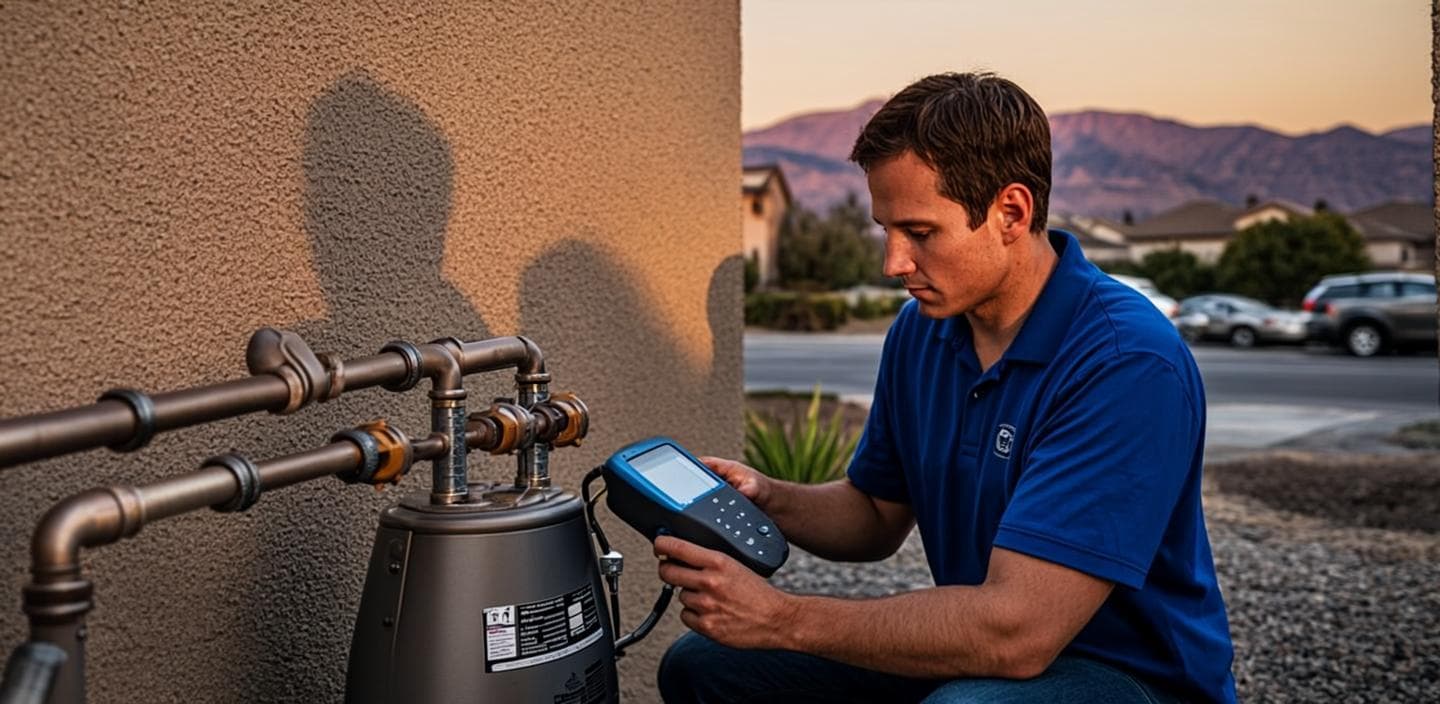
A rotten-egg smell that holds near the meter, a faint hiss behind the range, one stripe of dead grass over a buried run — gas leak clues are subtle until they're sudden. The right sequence is always safety first: leave, then call 911 or SoCalGas, whose emergency response is free. Once the scene is safe, our combustible-gas detector surveys, meter tests and isolated pressure tests pinpoint the leak on your customer-owned lines — the buried yard line, the runs through your walls, the connectors behind your appliances, the pool and fire-pit taps — so the licensed repair is small, permitted and certified with a re-test.
If gas could be present right now, we'll tell you to hang up and call 911 or SoCalGas at 1-800-427-2200 — their emergency response is free, 24/7, and it always comes first. Our inspection begins once the utility has made the scene safe, not before.
Detector + Pressure-Test Evidence
Calibrated combustible-gas surveys, meter leak-rate checks and isolated air pressure tests — each step logged. The result is a marked leak position with readings you can hand a contractor, not a guess with a wrench.
Non-Invasive Locating
We pinpoint from the surface — no exploratory trenching through patios, pool decks or lawns, no wall board opened to “lock around.” The only opening we recommend is the small one at the leak itself.
Repair-Ready Documentation
Every inspection produces a written report: detector readings, meter test results, the marked leak location on a sketch and photos — formatted for licensed gas contractors, city inspectors, insurers and escrow.
The Gas Line Specialist
What Is Gas Line Leak Detection?
Gas line leak detection is the discipline of finding unburned fuel escaping from a property's piping — before it finds an ignition source. Natural gas itself has no smell; utilities add mercaptan, the rotten-egg odorant, precisely so small leaks get noticed. Our work combines calibrated combustible-gas detectors that trace concentrations to their source, meter leak-rate checks that prove whether gas is escaping at all, isolated air pressure tests that name the failing run, bubble testing at accessible fittings and tracer gas for leaks under lawns, patios and pool decks. The goal is always the same: turn “we think we smell something” into a marked, measured, documented leak position.
The responsibility split matters, and most homeowners learn it mid-emergency: the utility owns and maintains the system up to and including the meter — everything downstream is customer-owned piping. SoCalGas states it directly: property owners are responsible for maintaining all customer-owned gas lines on their side of the meter, from the buried yard line to the connectors behind each appliance. That's why the utility's free emergency response stops at making the scene safe — stopping the flow, cordoning the area, restoring or capping service at the meter. Locating the leak on your lines, and getting it repaired by a licensed contractor, is the owner's job. We exist to make that job small.
Temecula has its own gas profile. The valley's biggest building booms — the tracts of Redhawk, Harveston and Wolf Creek in the 1990s and 2000s — coincide exactly with the era of yellow-jacketed CSST, which must be properly bonded to shrug off nearby lightning. Backyard lifestyle adds a dozen joints per property: pool and spa heaters, fire pits, BBQ stubs, outdoor kitchens. We sit in earthquake country, where routine ground movement works rigid pipe and fittings year after year. Old Town's historic buildings carry generations of re-piped runs. And west toward Wine Country and De Luz, properties beyond the gas main run on propane — which behaves differently: heavier than air, it pools instead of rising.
If You Smell Gas Right Now
The First Five Minutes Come Before Any Inspection
Nothing on this page matters more than this sequence. Gas leaks are the one plumbing-adjacent problem where the correct first move is to put down the phone and walk out. Here is the order fire departments and utilities give — and the order we give, every time, even when it costs us the call.
01
Leave Immediately
Get everyone out, including pets. Don't stop to open windows, grab belongings or hunt for the source — distance is the protection. Keep neighbors and visitors away from the area while you wait.
02
Touch Nothing That Sparks
No light switches, no garage-door openers, no phone calls from inside, no doorbells. Natural gas needs only a small spark. The switch you flip to “check” can be the ignition source — leave the house exactly as it is.
03
Call 911 or SoCalGas
Once you're clear of the building, call 911 — or SoCalGas directly at 1-800-427-2200, answered 24/7. Describe what you smell, hear or see, and where. If the odor is strong or anyone feels dizzy, 911 is the right call.
04
Let the Utility Make It Safe
SoCalGas responds at no charge: they stop the flow, test the atmosphere and restore or cap service at the meter. What they don't do is locate or repair the customer-owned lines beyond the meter — that part belongs to the property owner.
05
Then Have the Leak Located
With the scene cleared, that's our lane: detector surveys, meter tests and isolated pressure testing that pinpoints the leak on your yard line, house runs or appliance connections — so the licensed repair is one small opening, not a search.
Two distinctions that keep people safe
Natural gas leak vs. carbon monoxide: a gas leak is unburned fuel — your nose can find it. Carbon monoxide is odorless and comes from combustion problems; only a CO detector can catch it. Different danger, different tool — every Temecula home should have both covered.
Natural gas vs. propane: natural gas is lighter than air and rises — that's most valley homes on SoCalGas lines. Propane is heavier and pools in low spots — common on rural Wine Country and De Luz properties. Detector placement and testing differ; we test for both.
The utility response is free. Never let anyone talk you out of that first call — not a contractor, not a scheduling concern, not us.
Diagnose Before You Panic
Is It Really a Gas Leak — or Something That Smells Like One?
Not every sulfur-adjacent odor is gas, and treating the wrong smell costs a utility call-out and a week of anxiety — while dismissing the right one is far worse. Here's how the clues separate, and how we confirm which world you're in.
Points to a gas leak
A rotten-egg or sulfur odor that holds steady near the meter, an appliance, or one zone of the yard — and doesn't move when you run water or take out the trash
A hissing or faint whistle at the meter set, along an exposed run, or behind an appliance that uses gas
A stripe or patch of dead or dying vegetation over a buried run in an otherwise healthy yard
Bubbles rising in standing water — a puddle or irrigation runoff — above where a gas run crosses
A gas bill that climbs while your usage habits haven't changed
Pilots that won't stay lit, or appliance flames burning lazy and orange instead of crisp blue
Sewer gas — dried-out traps under an unused guest bath or a floor sink smell sulfur-like too; the odor is strongest at the drain itself and fades after water runs
Garbage, compost or fertilizer odors near bins and planters — organic sulfur smells that move with the wind and the trash schedule
Carbon monoxide — odorless by definition. A CO alarm, flu-like symptoms that clear when you leave, or a spreading headache indoors points to a combustion problem, not a leak you can smell
Musty or damp odors — microbial growth feeding on moisture is a water leak's signature; that's a different service page entirely
Paint, varnish or solvent fumes from recent projects — sharp and chemical, gone after ventilation
The tell: Gas odor doesn't follow the drains, the trash can or the weather — it holds its ground and gets bolder with time. When in doubt, treat it as gas: leave, then call 911 or SoCalGas. If the utility clears the scene and the symptom still doesn't add up, call (951) 393-1867 — we'll trace whether it's gas, sewer or water and put the answer in writing.
Know Your System
Your Gas System, Piece by Piece — and Where It Fails
Most Temecula homeowners can name their water heater but not their gas system's parts. Knowing the pieces explains where leaks hide, what the utility owns versus what you own, and why a precise locate matters before anyone digs or opens a wall.
01
The Meter Set & Regulator
The utility's responsibility ends at the meter, and the regulator downstream tamps supply pressure down for household use. The shutoff valve here is what the utility — or you, with a wrench — closes in an emergency, and it's where our meter leak-rate check starts.
02
The Buried Yard Line
From the meter to your foundation, usually yellow polyethylene (MDPE) in valley tracts. It shrugs off corrosion but not rock point-loads, settling soils or stray excavation. Leaks here surface as dead-vegetation stripes, bubbling puddles or blowing dirt.
03
House Runs & Black Iron
Inside the structure, threaded black iron carries gas through walls, attics and crawl spaces to each appliance drop. The pipe itself rarely fails — the threaded joints, unions and fittings age first, especially where runs pass through unconditioned spaces.
04
CSST — the Yellow-Jacket Line
Corrugated stainless steel tubing was installed heavily during the 1990s–2000s construction boom that built much of Redhawk, Harveston and French Valley. It's flexible and fast to run, but it must be bonded to the electrical grounding system — unbonded CSST can be perforated by arcing during a nearby lightning strike.
05
Appliance Connectors
The flexible stainless connectors behind ranges, dryers, water heaters and furnaces are consumables, not lifetime parts. Every move — a new stove, a relocated dryer, a pool-heater service — flexes them, and the coatings age out. This is the most common leak point we confirm indoors.
06
Outdoor Gas Features
Pool and spa heaters, fire pits, BBQ stubs and patio heaters add a dozen joints per property in Temecula's backyard-heavy lifestyle. Their lines run under patios and through planters, exposed to irrigation, sun and soil movement — a leak here often hides until the fire feature won't light.
Early Warnings
8 Signs of a Gas Leak Temecula Homeowners Should Never Sit On
Gas leaks rarely announce themselves with a whoosh. They leave patterns — in smells, sounds, vegetation and bills. Recognize one, act on it the same day.
01A Rotten-Egg Odor That Holds
Mercaptan is added to natural gas precisely so you can smell even small escapes. An odor that stays put near the meter, an appliance or one patch of yard — and doesn't wash away or move — is the classic signature.
02Hissing Near Meter or Lines
Gas under pressure leaving a fitting makes a sound — a hiss, a faint whistle, a low flutter at the regulator. Stand quietly near the meter set and each appliance run; the ear finds what the eye can't.
03A Stripe of Dead Vegetation
A buried yard line leak displaces oxygen and changes the soil above it. One browning stripe across an otherwise green Redhawk lawn — following a straight-ish path — is the buried leak's calling card.
04Bubbles in Standing Water
Irrigation runoff pooling over a leaking buried gas run will visibly bubble. It's one of the few gas leak signs you can photograph from a safe distance — and one you should never poke at.
05A Gas Bill That Climbs
Usage habits unchanged, number climbing month over month. Small leaks run constantly, and the meter counts every hour of it. The bill is often the first instrument to catch a leak you can't smell yet.
06Pilots & Flames Acting Wrong
A water heater pilot that won't hold, a furnace that short-cycles on safety, or range flames burning lazy and orange instead of crisp blue — supply and pressure changes upstream show up at the burner first.
07Symptoms That Clear When You Leave
Unexplained headaches, dizziness or nausea indoors that improve outside deserve the same seriousness as a smell. They're a reason to leave and call — not to tough it out for another evening.
08Dirt or Dust Puffing From Soil
Escaping gas moving through dry soil can lift dust above the run — utilities list blowing dirt among the primary outdoor signs. If you see it over your yard line's path, treat the area like a hazard and call.
Gas safety is one lane of our work — and Temecula properties rarely leak in just one system. Here's the complete toolkit behind the truck: every service available as a one-time locate or a scheduled inspection, with the same written documentation.
Gas piping is built to last decades — and mostly does. The failures we find trace back to a short list of causes, each with a Temecula signature.
01
Aging Joints, Unions & Fittings
Pipe walls last; threaded joints and compression fittings age faster — especially in attics that swing from cold winter nights to 110 degrees in July. Thermal cycling works every joint in the system, year after year, and the tired one lets go first.
02
Unbonded CSST
The yellow-jacketed CSST installed across the valley's 1990s–2000s building boom must be bonded to the home's grounding system. When it isn't, a nearby lightning strike can arc through the thin tubing wall and punch pinholes — on homes that never took a direct hit.
03
Earthquake-Country Ground Movement
Temecula sits on active terrain, and even modest quakes — plus chronic soil shrink-swell — work rigid pipe and rigid fittings. Buried yard lines shift; house runs torque at their connections. The damage shows up months later at the weakest joint.
04
Landscape & Excavation Strikes
Fence posts, pool excavations, tree plantings and patio builds are the most common cause of damaged yard lines. A gouge from a shovel can leak slowly for years — which is why calling 811 before every dig, and locating the line path before a project, matters.
05
Moved Appliances & Worn Connectors
A new refrigerator, a relocated dryer, a water-heater swap, a pool heater serviced — every move flexes a connector, and connectors are consumables. A surprising share of the indoor leaks we confirm live at a small part behind an appliance.
06
Unpermitted Additions & DIY Taps
Backyard makeovers and garage conversions sometimes come with uncertified gas taps — wrong fitting types, untested runs, no permit, no inspection. They hold until they don't, and they complicate escrow when a buyer's inspector finds them.
How We Find It
Gas Leak Detection Methods — Evidence Before Any Excavation
Gas leaks get located by stacking instruments, not by guesswork and wrenches. Each method below narrows the question — is gas escaping at all, which run is losing pressure, and where exactly — before anyone opens a surface.
01Combustible-Gas Detector Survey
A calibrated detector walks the system in sequence — meter set, each exposed run, every appliance connection, then the yard line path — with readings logged at each stop. Concentration gradients point toward the source, and the survey is non-destructive: it runs safely on live lines at household pressure.
02Meter Test & Leak-Rate Check
Every appliance and pilot off, then we watch the meter and regulator. Movement proves an escape and gives it a rate — how fast gas is leaving says a lot about how urgent the repair is. It's the same first test the utility performs, done again with documentation.
03Isolation & Air Pressure Testing
We section the system and pressurize each segment with air, then watch the gauge across a hold period. The line that drops is the line that leaks — a standard city inspectors accept, and the step that turns a whole-house mystery into one named run.
04Bubble Testing at Accessible Fittings
At exposed joints, unions and appliance connections, a soap-style solution turns escaping gas into its own map — steady bubble growth at an exact fitting. Crude, fast and visual, it's how a suspect spot gets confirmed on the spot.
05Tracer Gas for Buried Runs
For leaks under lawns, pavers, patios and pool decks, we isolate the run and feed it a safe, non-flammable hydrogen-nitrogen mix — the smallest tracer molecules in the toolbox. The tracer escapes at the break, and our surface detector marks the exact point through a foot of soil or a slab of concrete.
After the Locate
From Located Leak to Certified System
Gas pipe repair is licensed-plumber work — and our job is to make it surgical. Every path below ends the same way: the repair is made, the system is re-tested, and you have it in writing that the lines hold.
Surgical Access & Licensed Repair
Best for: Single-point failures with a precise locate
Because the leak is marked, the gas contractor opens one small area instead of trenching a yard or exploratory-opening walls. We stay through the repair to verify the fix addresses the located failure — then the system gets pressure-tested as a whole.
Permit & Inspection Coordination
Best for: Repairs that legally require a permit
Gas piping work in California is permit territory, and repairs get inspected. Our documentation — locate, readings, test results — is the file that keeps the city inspection moving, and the paper trail that keeps escrow clean on a sale.
CSST Bonding & Seismic Shutoff Upgrades
Best for: CSST-era homes & earthquake preparedness
If the inspection finds unbonded CSST or no seismic shutoff at the meter, we document it and coordinate the upgrade: proper bonding to the grounding system, and a seismic or excess-flow valve that closes the gas automatically when the ground moves.
Post-Repair Re-Test & Certification
Best for: After any gas line repair
Once the repair is made, we re-pressurize and re-scan the system and certify in writing that it holds — before drywall closes, before concrete pours, before the fire feature gets its first flame back. No repair is “done” until it tests done.
Transparent Pricing
What Gas Leak Detection Costs
Gas locating is quoted by the job, not by the hour of guessing. These are the honest ranges most Temecula homeowners see — confirmed with a straight quote when you call. And remember: the utility's emergency response is always free.
Gas Leak Inspection
$175–$450
Most residential calls
Full detector survey of the meter, house runs, appliance connections and the yard line path, plus a meter leak-rate check and written findings — typically completed in one visit without shutting down your home.
Isolated Pressure Test
$150–$400
When the leak hides
Section-by-section air testing to name the failing run when the detector survey alone can't close the case — the standard inspectors, contractors and insurers accept as proof.
Post-Repair Verification
From $125
Certify the fix
Re-test and re-scan after the licensed repair so the system is documented tight before surfaces close. Cheap insurance against a callback — and the certification inspectors like to see.
The utility's response is free — the locate is what you own
SoCalGas answers gas-odor calls 24/7 at 1-800-427-2200, responds at no charge, and makes the scene safe — stopping flow, testing the atmosphere, restoring or capping service at the meter. Their responsibility and their free service end there: everything downstream of the meter is customer-owned piping that the property owner is responsible for maintaining, per the utility's own guidance. That's the gap we fill — locating the leak on your lines, documenting it to permit and insurance standards, and coordinating the licensed repair and the re-test that closes the file. Gas work is also permit work in Riverside County, so any repair quote that skips “permit and inspection” is a quote that fails escrow.
Water leaks cost money. Gas leaks gamble with everything else. Four ledgers compound quietly while a gas leak runs — and none of them are forgiving.
01
Fire & Explosion Exposure
Escaping gas migrates — through wall cavities, under slabs, into valve boxes and crawl spaces — until it finds an ignition source you can't predict: a water heater's burner, a switch, a static spark. Accumulation is the enemy, and it builds silently.
02
Health Effects Compound
Low-level exposure reads like everything else — headaches, dizziness, fatigue, nausea — and it hits children, seniors and pets first. Symptoms that improve when you leave the house aren't stress; they're data. Treat them like data.
03
Code & Resale Complications
An unpermitted repair discovered at escrow stalls a sale and invites re-work at the worst possible price. A documented locate, a permitted repair and a passing pressure test keep the property's file — and its closing date — intact.
04
Odor Fade: the Leak You Can't Smell
The mercaptan that makes gas smell can be stripped by rust and oxidation inside aging pipe, and soil can mask yard leaks — the utility calls this odor fade. Detectors don't have noses; they find what yours can't. Small, odorless leaks run for years.
The Gas Line Detection Team Temecula Keeps on the Fridge
We're the local specialist — based at 33611 Blue Water Way, minutes from the meter sets of Redhawk, the pool-heater backyards of Harveston and Wolf Creek, Old Town's generations of re-piped buildings and the propane estates out toward Wine Country. The gas kit rides on the truck every day: calibrated combustible-gas detectors, manometers, pressure-testing rigs and tracer-gas equipment. And the first thing our team does on a suspected-leak call is what a good neighbor would do — confirm you've left the area and called 911 or SoCalGas first, because the free utility response always outranks a scheduled inspection.
Just as important: we never invent work. Plenty of “gas smells” turn out to be dry drain traps, and plenty of leaks live at a worn connector worth a few dollars. Our findings say what's there — leak, no leak, or “your concern is real but it isn't gas” — and the written report backs it with readings, not adjectives. When a repair is needed, we pinpoint it so the licensed contractor's opening is small, the permit passes, and the re-test certifies the system holds. That's why Temecula homeowners keep our number next to the utility's.
911 / SoCalGas-first safety protocol on every suspected-leak call
Detector surveys, meter tests & isolated pressure testing
Customer-owned lines covered: yard, house runs, connectors, outdoor features
CSST bonding & seismic shutoff checks on every inspection
Permit, inspection & licensed-repair coordination
Post-repair re-test & written certification
Related Services
Gas Problems Rarely Travel Alone
The trench that carries your gas yard line usually shares its history with water and sewer lines, and emergency calls rarely respect system boundaries. These are the services Temecula properties most often need alongside a gas locate.
From SoCalGas-served neighborhoods to propane-fed estates west of town, we work the gas systems of Southwest Riverside County daily — and we know how each community's housing stock was actually piped.
Also serving: Paseo del Sol, Vail Ranch, Morgan Hill, Temecula Creek, Chardonnay Hills, Crowne Hill, Old Town Temecula, Temecula Wine Country, De Luz, La Cresta, Lake Elsinore, Canyon Lake, Temescal Valley and more. Not on the list? Call (951) 393-1867 — if you're nearby, we'll find a way to help.
Gas Line FAQs
Questions? Let's clear things up.
Straight answers about gas leak detection in Temecula — the utility vs. customer-line split, pressure tests, CSST bonding, seismic valves, permits and what happens after the locate.
Have a different question?
Describe what you're smelling or hearing — a technician will walk you through it.
If you smell gas right now: leave, then call 911 or SoCalGas at 1-800-427-2200 — their emergency response is free, 24/7, and it always comes first. Utility crews make the scene safe — stopping flow, testing the atmosphere, restoring or capping the meter — but they don't locate or repair the customer-owned lines beyond it. Once the scene is cleared, we locate the leak on your yard line, house runs or appliance connections so the licensed repair is small, permitted and certified.
Safety First — Then Certainty
Get the Leak Located — and the System Certified
The utility stops the flow; we find the failure and prove the fix. One call gives you straight answers on inspection scope, pressure testing and the licensed repair path — before anyone opens a trench or a wall. Call (951) 393-1867 — we answer 24/7.