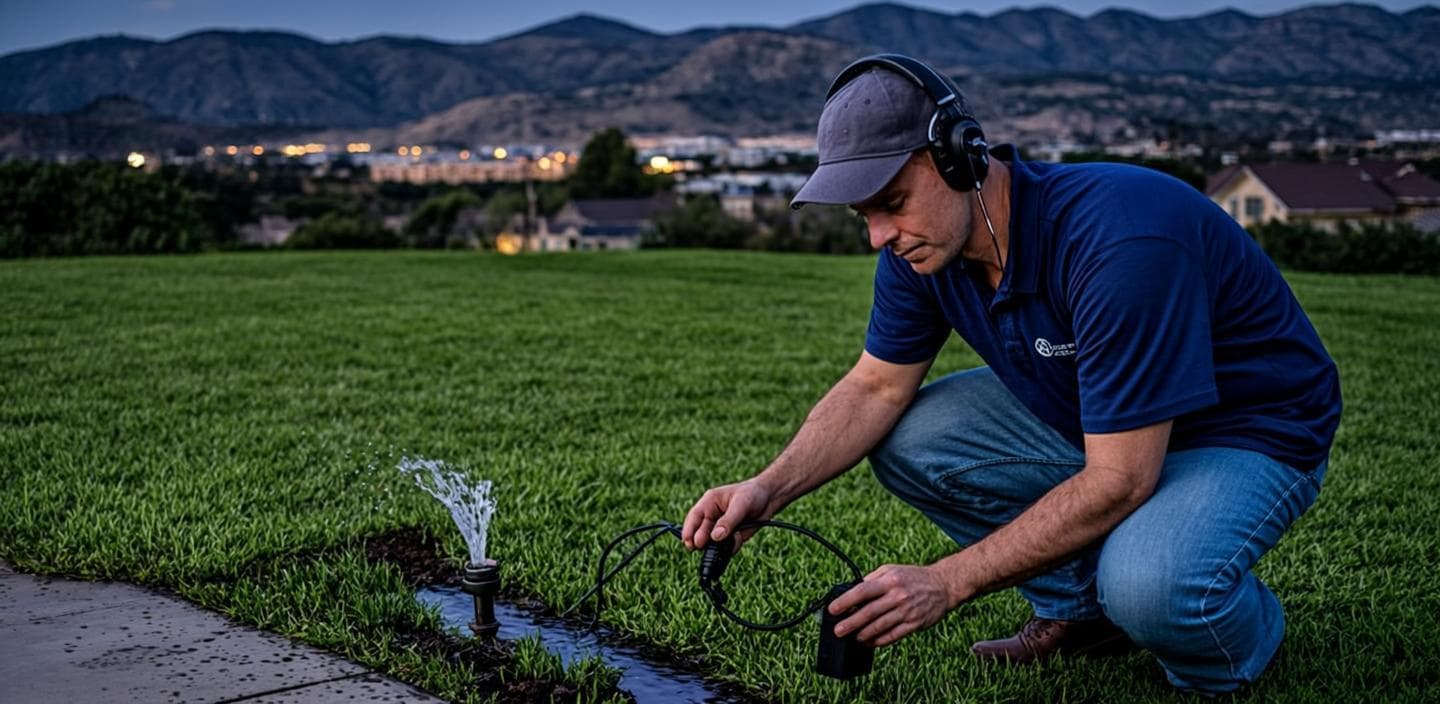
A wet patch that never dries, a dip forming in the lawn, a water bill climbing for no reason — somewhere under your property, a buried pipe is leaking around the clock. We pinpoint the exact break with ground microphones, leak correlation and tracer gas, then mark it so any dig is one small, surgical pit. No exploratory trenching. No torn-up yard on a guess.
Ground microphones, leak noise correlation and tracer gas mark the exact break — often within inches — before a shovel ever touches your soil.
Non-Destructive, Always
We never excavate to hunt for a problem. When a dig is needed, it's one small pit at the marked point — not a trench across your yard.
Insurance-Ready Documentation
Every investigation ends with a written report — location, cause, photos and readings — formatted for adjusters, water districts and HOAs.
Same-Day & 24/7 Response
Call before noon for same-day slots most days, with live emergency dispatch when water is surfacing fast or the ground is giving way.
The Basics
What Is an Underground Leak?
An underground leak is any break in the pressurized piping buried beneath your property — the water service line from the meter, yard and irrigation mains, pool and spa fill lines, even fire-supply and HOA common-area lines. Unlike a dripping faucet or a running toilet, these pipes are under constant street pressure 24 hours a day, so even a pinhole bleeds water into the soil day and night, whether anyone in the house turns on a tap or not. And because the entire run is buried, the evidence almost never shows up where the pipe actually is — it migrates, follows the path of least resistance, and surfaces yards away or not at all.
Temecula Valley properties are especially good at hiding these leaks. Expansive clay soil in the older tracts holds moisture and spreads it wide, blurring the wet spot's true origin. Decomposed granite on the hillside lots of Redhawk and Wolf Creek does the opposite — it drains evidence straight down, so the surface can stay bone-dry while a void grows underneath. Long front-yard setbacks mean some runs travel 50 to 100 feet from meter to house, crossing driveways and patios where a leak can undermine hardscape before a single drop is ever seen. Add a decade or two of drought-driven soil shrinkage and root competition, and buried lines across Southwest Riverside County are quietly working loose at the joints.
That's exactly why professional locating matters. Guess-digging an underground leak means tearing up lawns, hardscape and planting beds until you stumble onto the problem — and the repair bill grows with every wrong foot of trench. Modern leak detection flips the sequence: we prove the leak exists, map the line's route and depth, listen through the soil, and mark the precise break first. The dig that follows is small, deliberate and cheap by comparison — and the written report you receive is the same documentation your insurer and your water district's leak-adjustment program will ask for.
Know The Signs
8 Warning Signs of an Underground Water Leak
Buried leaks broadcast their presence in the soil, the hardscape and the bill long before water ever shows up indoors. The tricky part: every symptom below can have an innocent explanation too — overwatering, soil settling, a tired pressure valve — which is precisely why testing beats guessing. If one or more of these sounds familiar, a locating visit usually settles the question in a single morning.
01Wet Areas That Never Dry
A patch of yard, gravel or planter that stays damp through a dry week — or with the irrigation zone shut off entirely — has a water source feeding it from below. Persistent dampness over a known pipe run is the clearest signal there is.
02The Meter Creeps With Everything Off
Close every fixture, valve and irrigation controller, then watch the meter's low-flow indicator. If it keeps ticking forward, water is escaping somewhere on your side of the system — and buried lines are the most common culprit.
03One Strip of Lawn Suddenly Lush
A single stretch of grass that's greener, thicker and faster-growing than everything around it is feeding on a constant subsurface supply. It's the classic underground-leak tell — especially striking outside watering season.
04Sink Spots, Dips & Settling Soil
Escaping water carries soil away with it. Depressions in the lawn, gravel that keeps raking itself level, pavers or walkway sections that start to tilt — all mean a leak below has been eroding the ground for a while.
05Wet Seams Along Driveways & Walkways
Water travels under slabs until it finds a joint to escape through. A driveway edge, expansion seam or walkway crack that weeps after dry days — or pavement that lifts and cracks with no traffic to blame — points to a break beneath the hardscape.
06Hissing or Bubbling Underfoot
Pressurized water escaping through soil makes a distinct hiss. Stand quietly near the suspected area with appliances off — an audible rush from below ground, or unexplained bubbling in puddles and pond water, deserves a same-week test.
07Household-Wide Pressure Drop
One weak shower is a showerhead; every weak fixture is a supply problem. When pressure sags across the whole house — or an irrigation zone loses pop-up force — a leak upstream in a buried line is bleeding off supply before it ever reaches you.
08Bill Spikes & Water-Waste Notices
A Rancho Water or EMWD bill that climbs two cycles straight — or a water-waste letter during drought restrictions when you know you haven't changed your habits — is often the first paper trail a hidden yard leak leaves behind.
Beyond the Yard: Every Leak Detection Service We Offer
Buried supply lines are just one of the hidden runs we track down. The same licensed Temecula team, the same non-invasive technology and the same flat-rate, insurance-ready reporting cover every service below — from the pipes beneath your floors to the mains under your street.
What Causes Pipes to Leak Underground in Temecula?
Buried lines rarely fail at random — they fail for a handful of predictable reasons, and our valley accelerates several of them. Knowing the cause matters as much as finding the break: it decides whether a spot repair will hold or whether the whole run is living on borrowed time. Our reports always document cause, so your repair decision is informed, not gambled.
01
Age, Corrosion & Hard Water
Copper thins from the outside in valley soils, and from the inside out where Temecula's hard water leaves mineral scale. Where one pinhole opens on an aging run, more are usually forming — which is why we always pressure-test the rest of the line before recommending a spot fix.
02
Drought Cycles & Soil Movement
Southwest Riverside County's clay soils swell with irrigation and shrink hard through dry spells. Year after year, that flexing works fittings loose and fatigues rigid pipe — one reason so many yard leaks surface at the end of a long, hot summer.
03
Tree & Shrub Root Intrusion
Pepper trees, eucalyptus, ficus hedges and thirsty ornamentals all hunt for moisture along buried lines. Roots wrap, compress and eventually breach pipe walls and joints — and an already-leaking line announces itself to the whole root system.
04
Pressure Spikes & Water Hammer
Street pressure in some Temecula zones runs high, and every quick valve closure sends a shockwave through buried runs. Sustained high pressure plus water hammer is hardest on aging joints — and it's measurable in our tests.
05
Installation Defects & Fitting Failures
A kinked run, an over-flared joint, pipe laid against sharp granite rock or buried too shallow — many underground leaks trace back to the original installation and surface years later under pressure, traffic loads and soil movement.
06
Ground Disturbance & Surface Loads
Landscaping trenches, fence posts, patio footings, delivery trucks parked over a shallow run — surface activity cracks rigid pipe and finishes off marginal sections. If your symptoms started soon after yard work, say so; it narrows the search fast.
Our Method
How We Find Buried Leaks Without Digging Up Your Property
The goal on every underground call is identical: prove exactly where the leak is before a shovel touches soil, so the repair dig is one small, surgical pit at the marked point. Depending on the run, we stack two or three of the methods below until the evidence agrees — most investigations wrap in one to three hours and end with the break marked, photographed and documented in writing.
01Line Isolation & Pressure Testing
First we prove which line is losing water: with the plumbing sectioned and fixtures closed, we watch pressure hold or fall run by run — ruling out toilets, irrigation valves and the slab until only the buried suspect remains.
02Acoustic Ground Microphones
Sensitive ground microphones and headset amplifiers listen straight through soil, grass, gravel and concrete for the hiss of pressurized water escaping, walking the line's path until the sound peaks over the actual break.
03Leak Noise Correlation
For long, deep or quiet runs, two sensors listen at opposite ends of the pipe and a correlator calculates the leak's position from the difference in arrival times — pinpointing the break mathematically, not by ear alone.
04Electromagnetic Line Tracing
A locator signal sent along the pipe maps its exact route and depth across your property — under lawns, driveways and walkways — so we hunt for the leak along the real line, not where we assume it runs.
05Tracer Gas Pinpointing
For silent, stubborn or deep leaks, we feed a safe 5% hydrogen / 95% nitrogen mix into the isolated line. Lighter than air, the gas escapes at the break and percolates up through soil and hardscape, where a sensitive detector marks the exact spot.
Once the leak is pinpointed, the right fix depends on the pipe's age and material, how deep it sits, what covers it, and whether the rest of the run tested sound. Here are the four approaches we quote most on buried-line calls — and when each one genuinely makes sense. After detection, we price every option that applies, flat-rate, in writing.
Spot Repair
Best for: A single, isolated break in an otherwise sound line.
We open one small pit at the marked point, cut out the damaged section and couple in new pipe. It's the fastest, least invasive true repair — but only sensible when the rest of the run holds pressure. On aging lines, a spot fix can simply schedule the next dig, so we always test the whole run first.
Section Replacement
Best for: A crushed, corroded or root-damaged stretch within a sound line.
When a stretch of pipe is compromised but the balance of the run checks out, we replace the failing section along a compact trench and restore the surface. It's the middle ground between a spot fix and a full replacement — and the right call more often than homeowners expect.
Full Line Replacement (Trench or Trenchless)
Best for: Old, repeatedly leaking or end-of-life buried runs.
When the whole run is tired, replacing it solves the problem for decades. Open-trench replacement follows the existing route; where access allows, trenchless methods pull or burst the new line through with just two access pits — sparing driveways, patios and mature landscaping.
Irrigation Mains & Specialty Lines
Best for: Sprinkler mains, pool and spa fill lines, HOA common lines.
Not every buried leak feeds the house. Sprinkler mainlines, pool fill lines and shared HOA runs fail just as often — and fixing them takes different parts and pressures. We locate on those systems too, then repair or coordinate with your landscaper or association so the fix matches the line.
Costs & Coverage
How Much Does Underground Leak Detection Cost in Temecula?
Underground work is priced by depth, surface and reach — the deeper the line and the harder the hardscape above it, the more a repair costs to open and restore. Rather than hiding behind "it depends," here's an honest framework of what Temecula-area properties typically pay, anchored to published regional data, with a flat-rate quote approved before any work begins.
Underground Leak Detection
$150–$450
Flat rate, quoted upfront
Most buried-line investigations land in this range depending on run length and complexity — and the fee is credited toward the repair when we perform it.
Spot & Section Repairs
≈$650–$2,500
By depth, surface & materials
Published industry data puts most underground water line repairs between roughly $650 and $5,000 — shallow lawn breaks sit at the low end of our band, while runs under driveways and rock cost more to open and restore.
Full Line Replacement
≈$1,700–$6,000+
$50–$150+ per linear foot
Regional data puts average full replacements around $1,700–$2,800, with long rural runs, deep lines and trenchless installs reaching higher. We quote per foot, in writing.
Insurance & Your Water District Leak Adjustment
Two pots of money may apply — and most property owners only know about one. First, homeowners insurance generally covers sudden, accidental water damage — a flooded yard, an undermined walkway — but not the pipe repair itself, and gradual leaks that ran for months are where claims get disputed. Second, your water district's leak adjustment: Rancho California Water District, EMWD and other valley agencies credit part of the charges for water lost once you document the repair. Both depend on the same evidence — exact location, documented cause, photos and proof of the fix — which is precisely what our written report and repair paperwork provide. Don't close the file until both have been claimed.
An underground leak never heals itself — it only widens its footprint. Pressurized water runs 24/7 whether anyone uses it, and every week it keeps going, more of the cost shifts from plumbing to hardscape, soil and structures. Here's what's actually at stake while the leak keeps running beneath your property.
01
Voids & sinkholes under hardscape
Water escaping beneath driveways, patios and walkways washes out their bedding. Slabs lose support, crack and settle — turning a plumbing repair into concrete and masonry work on top.
02
Slope & hillside erosion
On Temecula's hillside lots, a leak is more than a nuisance — escaping water lubricates and undermines slopes, gouges erosion channels and can destabilize retaining walls and landscaping built to hold the grade.
03
Foundation & structural moisture
Subsurface water migrates toward footings, stem walls and slab edges. Persistent moisture there erodes bearing soil, feeds mold and draws subterranean termites — how a yard leak becomes a structural conversation.
04
Fines, bill shock & a bigger dig
Drought-era water-waste rules can mean district notices and fines on top of the wasted gallons. And every week of soaking lets roots and shifting soil expand the damage — what was a one-pit fix becomes a section or full replacement.
Why Temecula Property Owners Call Us First for Buried Leaks
Finding leaks under the ground is our specialty, not a side service — and knowing this valley is half the skill. Our technicians work the Temecula Valley every day and know how its neighborhoods are actually piped: the long meter-to-house runs and driveway crossings of Redhawk and Wolf Creek, the high water table around Harveston Lake, Paloma del Sol's HOA common lines, Menifee's long rural runs, and the grove irrigation feeding Fallbrook's avocado acreage. We also know the ground itself — where expansive clay smears the evidence and where decomposed granite hides it — so we read your symptoms against the right soil, not a national playbook.
Every investigation ends with an insurance-ready written report — exact location, documented cause, photos and pressure readings — plus flat-rate options for the fix with zero obligation to use us for the repair. We're licensed, bonded and insured, our technicians are background-checked and factory-trained on acoustic, correlation and tracer-gas equipment, and we answer calls 24/7, including nights, weekends and holidays.
Specialists only — locating hidden leaks is our entire business, never a side service.
Non-destructive methods — we never trench or dig to hunt for a problem.
Reports insurers, water districts & HOAs accept — location, cause, photos and readings.
Local and fast — based at 33611 Blue Water Way, minutes from your door.
Related Services
Other Leak Detection Services You May Need
Not every hidden leak lives under the yard's open ground. If your symptoms point elsewhere, these related services share the same non-destructive approach and the same insurance-ready reporting.
Underground Leak Detection Across the Temecula Valley
We trace and pinpoint buried leaks on every kind of property we serve — slab tract homes in Temecula's 92592 ZIP code, hillside estates in Murrieta, long rural runs out toward Menifee and Winchester, and grove and estate lines through Fallbrook. Our technicians are already in your area every day.
Also serving: Paseo del Sol, Vail Ranch, Morgan Hill, Temecula Creek, Chardonnay Hills, Crowne Hill, Old Town Temecula, Temecula Wine Country, De Luz, La Cresta, Lake Elsinore, Canyon Lake, Temescal Valley and more. Not on the list? Call (951) 393-1867 — if you're nearby, we'll find a way to help.
Underground Leak FAQs
Questions? Let's clear things up.
Straight answers about buried pipe leaks in Temecula — how locating works, DIY checks, tracer gas safety, costs, insurance and depth — the same answers we give on the phone every day.
Have a different question?
Tell us what you're noticing — a technician will walk you through it.
We stack methods until the evidence agrees. Line isolation and pressure testing first prove which buried run is losing water; electromagnetic tracing maps that pipe's exact route and depth; then acoustic ground microphones and leak noise correlation listen through the soil to the hiss of escaping water. For silent or deep leaks we add tracer gas — a safe hydrogen-nitrogen mix that escapes at the break and surfaces where a detector marks the exact point. Only after all of that do we open the ground, and even then it's one small pit at the marked spot, not an exploratory trench.
Suspect a Leak Under Your Yard?
Get It Pinpointed — Before the Ground Gives Way.
Call and describe what you're noticing — a never-dry patch, a sink spot, a bill that jumped. We'll book the earliest same-day slot, pinpoint the leak without digging, and hand you a written plan for the fix.