Serving Temecula & Nearby Communities

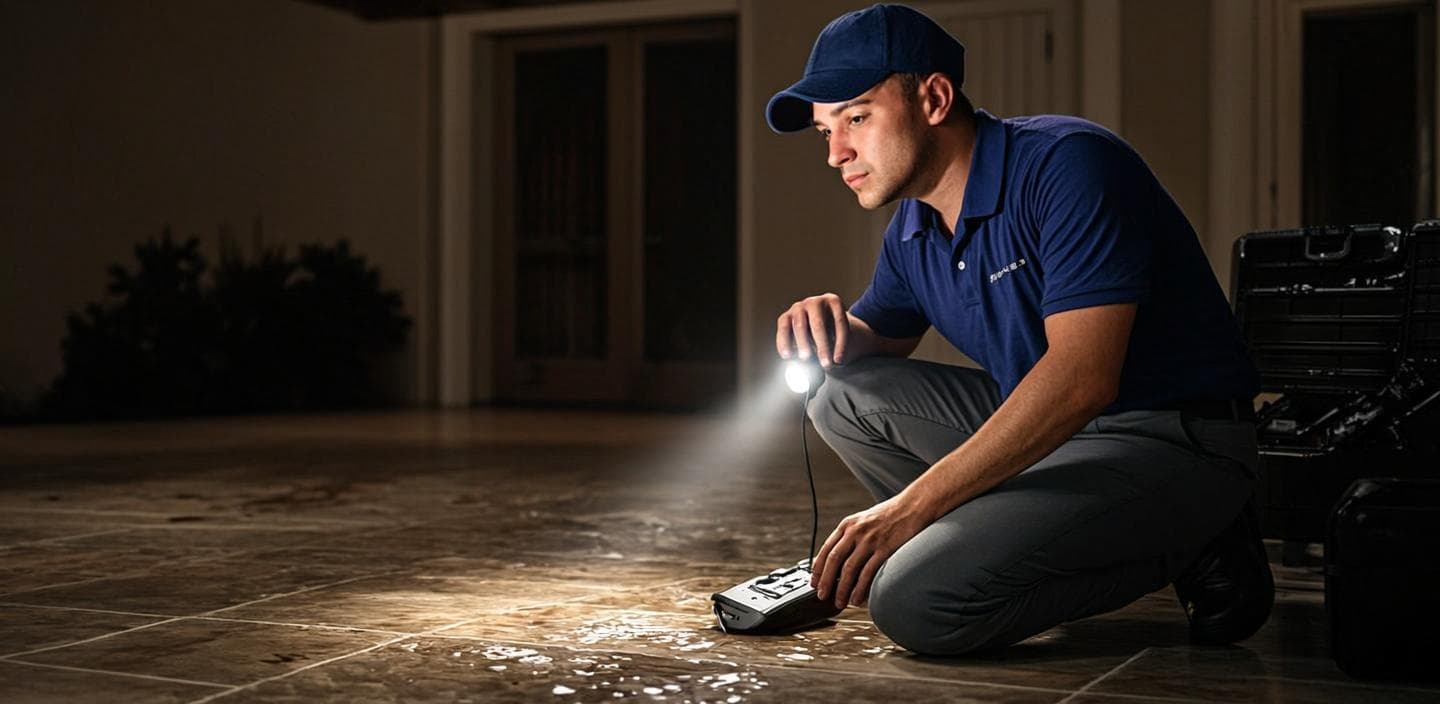
Emergency leak detection technician with flashlight and acoustic equipment locating a nighttime water leak in a Temecula, CA home

24/7 Rapid Response · Temecula, CA

Emergency Leak Detection in Temecula, CA

Water is where it should never be — a ceiling dripping, a wall hissing, a heater pouring into the garage. Every minute costs more than the last. Call and get a live technician on the line, shut-off guidance while we roll, and a specialist who pinpoints the leak without opening your walls on a guess — day, night, weekend or holiday.

  • Live Dispatch 24/7 — Nights & Holidays
  • Phone Triage While We Roll
  • Licensed, Bonded & Insured

Triage on the First Call

The voice you reach is a technician, not a call center. While you're still on the line, we walk you through shutting off water, power and the heater — then dispatch.

Pinpointed, Not Hacked Out

Most 24/7 crews find leaks by opening walls until they see water. We arrive with acoustic, correlation and tracer-gas gear, so even a 2 a.m. repair is one small opening.

Claim-Ready From Minute One

Emergency visits are documented like an investigation: photos, moisture readings, exact location and cause — the evidence your adjuster will ask for first.

Local Crew, Short ETA

We're based at 33611 Blue Water Way, not dispatched from two counties over. Temecula core addresses typically see us well inside the hour, with a live ETA when you call.

The Emergency Difference

What Is Emergency Leak Detection?

Emergency leak detection is the urgent, same-visit version of our specialty: a leak is actively damaging your property right now — water surfacing, spreading or pouring — and you need two things fast. First, stop or contain the water. Second, find exactly where it's coming from so the repair is small, deliberate and done once. It's a different job from a scheduled investigation: the clock is running, materials are soaking, and every decision in the first hour affects the final insurance claim.

This is where a detection specialist differs from an after-hours general plumber. A 24/7 plumbing crew's instinct is to start cutting — exploratory holes in drywall, a trench across the yard, a jackhammer guess at the slab — because locating equipment is expensive and rarely on their truck. We take the opposite approach, even at 3 a.m.: isolate the system, prove which line is failing, and pinpoint the break with sound, correlation math or tracer gas before a single hole is opened. The emergency stays small — one access point instead of a demolition trail.

It also matters who you call first. Temecula homes fail in patterns — water heaters letting go in garages overnight, supply lines behind washing machines, cold-snap splits on exposed piping each winter, irrigation breaks flooding slopes — and a specialist who hears your symptoms can often name the likely culprit and its shut-off sequence before anyone arrives. That phone triage routinely saves homeowners thousands of gallons and hours of saturation, which is why we staff the line with technicians rather than an answering service.

Emergency or Not?

Call Now — or Can It Wait Until Morning?

Not every leak is a midnight emergency, and knowing the difference protects both your property and your wallet. Shut the water off at the main and most leaks stop being urgent; some situations, though, can't safely wait an hour. Here's the same triage our technicians run through on the phone — if anything in the left column matches, skip the checklist and call.

Call Now — Don't Wait

  • Water is actively dripping or pouring from a ceiling, or drywall is bulging with trapped water.
  • You can hear water running or hissing behind a wall and can't shut it off.
  • The water heater or a supply line is releasing water faster than a towel can hold it.
  • Water is near electrical panels, outlets or appliances — any shock risk moves this to the top.
  • The meter spins with everything shut off and water is surfacing in the yard, under cabinets or through floors.
  • A slope, hillside or driveway is eroding — moving water is undermining ground or hardscape now.
Any of these? Call (951) 393-1867

Water Off? This Can Usually Wait for Morning

  • A slow drip at a visible fixture or shutoff valve — contained, draining to a sink or bucket.
  • A damp spot on carpet or drywall that is stable, not growing, with the meter holding still.
  • A toilet that runs or a faucet that drips — annoying and wasteful, not destructive.
  • A small sprinkler head or lateral leak — close the irrigation controller and the zone valve, then book a daytime slot.
  • A water stain that's dry and old with no active moisture — schedule a scheduled investigation instead.
Book a daytime visit

The tiebreaker: The tiebreaker: shut off the main. If the water is off, the damage is paused and a morning visit is usually safe. If you can't find the shutoff, the meter keeps moving, or anything in the left column is true — treat it as an emergency and call. If you ever smell gas alongside a leak, leave and call 911 first; for sparking electrical hazards, keep everyone clear and call your utility.

Do This First

The First 10 Minutes: What to Do Before We Arrive

The actions you take in the first ten minutes decide how big this loss becomes — and how well your insurance claim goes. Run this sequence in order; the whole thing takes less time than filling a bucket. If you get stuck on any step, stay on the phone with us and we'll talk you through it while the truck rolls.

  1. Shut off the house main

    In most Temecula homes the main shutoff is a gate or ball valve on the supply line where it enters the house — commonly on the wall near the water heater in the garage, at the front of the house near the hose bib, or inside the garage itself. Turn the handle clockwise until it stops. Can't find it? The curb stop in the meter box at the front sidewalk works too — most Rancho Water boxes need a meter key or a long screwdriver; twist the city-side valve a quarter turn.

  2. Kill power to the water heater

    An electric heater keeps drawing power into standing water; a gas heater keeps a burner lit. For electric, switch off the dedicated breaker (or the unit's disconnect switch). For gas, turn the thermostat dial to PILOT/OFF. Then close the cold-water inlet valve on top of the tank — a 40–50 gallon heater keeps refilling from the street until you do.

  3. Cut electricity to wet areas

    If water is near outlets, baseboards, or your electrical panel, shut off the affected circuits at the panel — and if water threatens the panel itself, do not touch it; keep everyone away and tell us immediately. Never step into standing water that could be energized, and unplug appliances only if you can do so without touching wet surfaces.

  4. Drain the pressure, open the faucets

    With the main off, open the lowest faucet in the house — often a garden spigot or the downstairs tub — plus a hot-side tap, so remaining water and pressure drain out of the pipes instead of out of the leak. Flush toilets once to empty the tanks. This turns a pressurized spray into a quiet, manageable drip.

  5. Document everything before cleanup

    Photograph and video every wet surface, the leak's origin, the meter reading and any damaged belongings — before anything is moved or dried. Adjusters evaluate what they can see, and early evidence separates a 'sudden and accidental' event from a 'gradual damage' dispute. Then keep every receipt for mitigation.

  6. Start moving water out

    Towels, a wet/dry vacuum, furniture lifted onto blocks, rugs rolled outside — every gallon you lift now is a gallon that doesn't wick into subfloor and baseboards. Punch weep holes only if a ceiling is actively bulging and drain it into a bucket; otherwise leave the ceiling alone for us to assess.

Act-Now Symptoms

8 Signs You Need an Emergency Leak Call — Not a Next-Week Appointment

Emergencies rarely announce themselves politely; they escalate by the hour. Any of these symptoms means water is moving somewhere it can do structural damage fast — the sooner the source is stopped and pinpointed, the smaller the repair and the cleaner the claim. If you're seeing more than one, treat it as a 911-for-plumbing and call immediately.

A Ceiling That's Bulging or Dripping

Trapped water above a ceiling spreads across the drywall panel until it sags — and one foot of saturated half-inch drywall holds gallons before it lets go. A bulge, brown ring or active drip above means the supply or drain above has already been running for a while. Stay out from under it and call.

A Line, Valve or Hose Bib Pouring Water

A split washing-machine hose, a burst angle stop behind a toilet or a sheared hose bib releases street pressure continuously — hundreds of gallons an hour — and no towel competes with that. Shut the main and treat it as an active flood, not a repair appointment.

The Water Heater Is Leaking or Has Let Go

A tank failure doesn't drip — it empties. Forty to fifty gallons hits the garage floor in minutes, and the cold inlet keeps refilling until someone closes it. Garage heaters also put water next to stored belongings and, in gas units, next to a burner. Kill power or gas, close the inlet, and call us.

Rushing or Hissing Inside a Wall

If you can hear water where no fixture is running — a hiss, a rush, a ticking in the stud wall — a pressurized line has opened. Drywall hides the scale of it, which is exactly why walls get hacked open unnecessarily. We can hear through it and pinpoint the break before anything is opened.

The Meter Spins While Water Shows Up

Everything shut off, meter still climbing, and now water is surfacing — through a floor, a cabinet base or the yard. That combination means an active pressurized leak feeding the damage in real time. It's the single clearest emergency signature there is.

A Yard Geyser or a Slope Washing Out

A mainline break can lift soil and spray like a geyser; on Temecula's hillside lots, a broken line undermines slopes and retaining walls with startling speed. Ground that's visibly moving, cracking or sliding is a structural emergency, not a landscaping one.

Warm Floor or Sudden Slab Heat

A hot spot on the floor — or carpet that goes damp and warm near a slab — is a hot-water line leaking under the foundation. Hot leaks damage faster than cold ones and quietly feed the water heater all day. In a slab home this is the classic emergency precursor to a full slab failure.

Water Anywhere Near Electricity

Water approaching panels, outlets, or under-floor HVAC — or lights flickering as a leak spreads — outranks every other symptom. Keep everyone clear, don't touch wet fixtures, and if it's safe at the panel, cut the affected circuits. Then call us; we coordinate with your electrician on anything we can't touch.

Our Services

Every Leak Detection Service We Offer

Emergency response is one branch of the same specialty. The same licensed Temecula team, the same non-invasive technology and the same flat-rate, insurance-ready reporting cover every service below — so once tonight's crisis is handled, the follow-up is already in familiar hands.

Slab Leak Detection & Repair

Pinpoint hot spots, damp floors & the sound of running water under your foundation.

  • Electronic & acoustic under-slab pinpointing
  • Hot-spot thermal mapping for hot water slab leaks
  • Repair vs. reroute options with upfront pricing
Get Leak Help

Main Water Line Leak Detection

Find leaks between your water meter and your home before they undermine driveways.

  • Meter-to-home line pressure testing
  • Leak verification with meter isolation tests
  • Documentation for your water district & insurer
Get Leak Help

Underground Leak Detection

Sonic, tracer-gas & pressure testing to locate buried pipe leaks without digging.

  • Ground microphone & leak correlation surveys
  • Safe tracer-gas pinpointing under hardscape
  • Surgical, minimal-dig verification
Get Leak Help

Emergency Leak Detection

24/7 rapid response when a leak is flooding your home or flooding your yard.

  • 24/7 live emergency dispatch
  • Priority response for active flooding
  • Fast locating so repairs start sooner
Get Leak Help

Sewer Line Leak Detection

Camera inspections & hydrostatic testing that reveal breaks, roots & bellies.

  • HD sewer camera inspection with locator
  • Hydrostatic & isolation testing under slabs
  • Video documentation of every finding
Get Leak Help

Commercial Leak Detection

Restaurants, retail, offices & multi-unit properties across the Temecula Valley.

  • Restaurants, retail, offices & HOAs
  • After-hours & low-disruption scheduling
  • Reports formatted for insurers & managers
Get Leak Help

Gas Line Leak Detection

Safety-first combustible gas detection for your home, yard & appliances.

  • Combustible gas detector surveys
  • Pressure testing for yard & house lines
  • Clear findings for licensed gas repair
Get Leak Help

Not sure which service fits your situation? Describe the symptoms when you call (951) 393-1867 — we'll dispatch the right detection method. Or explore all 8 services in detail.

Why Pipes Let Go

What Makes Pipes Burst Suddenly in Temecula Homes?

Sudden failures feel random, but they almost never are — pipes telegraph their decline until one final stress finishes them. Valley homes have their own regular offenders, and knowing which one hit you matters for the repair decision and the insurance file alike. These are the six we see most on after-hours calls across Temecula, Murrieta and the surrounding communities.

Hard Water Scale & Pressure Spikes

Temecula's hard water leaves mineral scale inside supply lines, narrowing flow and roughening walls where corrosion accelerates. Add street pressure that can run high in several zones, and aging lines develop pinholes that tear open under a pressure spike — often first thing in the morning when demand surges.

Valley Cold Snaps

It doesn't take a Midwest winter — a handful of freezing nights each December through February is enough to split exposed piping: garage runs, hose bibs, vacuum breakers and attic lines in tract homes. The split shows itself not during the freeze but on the first warm morning the ice thaws and water sprays.

Water Hammer & Fatigued Joints

Every slamming washing-machine valve and quick-closing dishwasher inlet sends a shockwave through the system. Years of hammering work solder joints and fittings loose — which is why bursts so often happen at a joint right behind an appliance, and why we ask what was running when the leak started.

Drought Shrink, Then Sudden Rain

Southwest Riverside County's clay soils shrink away from buried lines through long dry spells, then swell violently with the first storms. That flexing snaps brittle fittings and shifts rigid runs — a big reason yard-line failures cluster around the season's first heavy rain after a dry fall.

Aging Supply Hoses & Fixture Connections

Braided stainless washing-machine hoses, toilet connectors and dishwasher lines all carry a service life most owners never think about. Rubber washers embrittle, braids corrode at the crimps, and the failure is always sudden and always at full household pressure — usually while nobody is home.

Water Heaters at End of Life

Sediment rumbling, a tired anode rod and years of thermal cycling thin a steel tank from the bottom up. Tank failures give little warning beyond rusty water or a slow weep at the fittings — and they choose 2 a.m. on a holiday weekend more often than any scheduling algorithm would predict.

Our 24/7 Process

How Our Emergency Leak Response Works, Hour by Hour

A midnight call should feel less like rolling the dice and more like a procedure. Ours is the same every time, whether it's Tuesday noon or Christmas morning: stabilize first, pinpoint second, document throughout. Here's exactly what happens from the moment you dial to the moment the water is stopped and the plan is in writing.

  1. You Call — a Technician Answers and Triages

    No menu, no callback promise. We confirm the danger first — electricity, gas, ceiling under load — then walk you through the shutoff sequence while the on-call tech gets ready. You'll know within minutes whether we're talking minutes or hours, and what to do until we're there.

  2. Live Dispatch With a Real ETA

    We roll from Blue Water Way with the truck loaded for location work — acoustic kit, correlating sensors, tracer gas, pressure rig. You get a straight ETA, not 'someone will call you back.' Temecula-core addresses are typically well inside the hour; outlying areas we quote honestly on the phone.

  3. Arrival: Isolate, Protect, Stabilize

    First we make the scene safe — verify shutoffs, drain pressure, shield belongings and move standing water where it threatens materials. If the main had to stay off, we set up temporary water plans so your household can function while we work. Damage stops expanding from this point.

  4. Pinpoint the Leak — No Demolition

    Now the specialty part: isolation testing proves which line failed, acoustic listening and correlation narrow the location, tracer gas marks silent breaks exactly. You see the evidence — readings, sounds, the marked point — before any wall, slab or yard is opened, at any hour.

  5. Stabilize, Repair or Plan — in Writing

    Some leaks get stabilized on the spot; many get repaired the same visit at the marked point; all of them get a written report — location, cause, photos, readings — plus flat-rate options for the fix. That report is what your insurer and water district will ask for, and you have it before we leave.

Same-Night Options

Emergency Stabilization and Repair Options, Explained

Once the leak is pinpointed, tonight's goal is simple: stop the water for good, or stop it well enough that nothing is damaged by waiting for parts. We price every applicable option flat-rate, in writing, before work begins — you're never agreeing to a running meter at 2 a.m. These are the four paths most emergency calls take.

Emergency Stabilization

Best for: Buying control when the system can't stay off all night.

We isolate and cap the failing section, drain the line and confirm the leak is fully stopped — so the main can come back on for the rest of the house. It's the move that keeps a family functional overnight and limits damage while a repair is scheduled, and it's often done within the first hour on site.

Spot Repair at the Marked Point

Best for: A single clean break the rest of the line has tested sound.

One small opening at the pinpointed location, the damaged section cut out and new pipe coupled in, pressure-tested before we close up. Because the location was proven with instruments first, the hole is measured in inches — not the exploratory demolition most after-hours calls brace for.

Section or Full-Line Replacement

Best for: Runs that fail pressure testing beyond the visible break.

When testing shows more of the line is compromised, we'll show you why — readings, not opinions — and quote section replacement or a full re-route, open-trench or trenchless where access allows. Emergencies are when upgrade decisions get forced; we make sure you decide them with numbers, not adrenaline.

Dry-Out Coordination & Claim Documentation

Best for: Anything water already touched before we arrived.

Stopping the leak is half the emergency; the other half is the hours of saturation behind it. We hand you a documented report — location, cause, photos, moisture readings — and coordinate with trusted extraction and drying crews, so the restoration file and the plumbing file tell the same story.

Costs, Honestly

What Does an Emergency Leak Call Cost in Temecula?

Emergency pricing has a reputation, and industry data earns it: published 2026 surveys put emergency plumbers at $100–$500 per hour, with after-hours and holiday rates climbing past $600, plus $75–$200 call-out fees that some companies charge just to knock. Our answer is simpler — a flat rate, quoted on the phone and before any work starts, the same at noon or midnight.

Emergency Detection Visit

$150–$450

Flat rate — day, night or holiday

The same investigation-based flat rate as our scheduled visits, because finding a leak precisely is the same work whether the sun is up. No after-hours multiplier, and the fee is credited toward the repair when we perform it.

Emergency Stabilization

≈$200–$600

By access & materials

Isolating the failing run, capping or valving it off, draining the system and confirming the stop — the work that lets your water come back on tonight. Simple garage-supplier caps sit at the low end; buried or multi-line isolations run higher.

The Repair Itself

From ≈$650

Spot fixes to full replacements

Spot repairs at a marked point start around $650; section work and full replacements scale with depth and surface — regional replacement averages run $1,700–$2,800 and upward for long or deep runs. Every option is flat-rate, in writing, before we begin.

Insurance, Mitigation Duty & the 48-Hour Mold Clock

Three things decide how much of this emergency your policy pays for. First, coverage: homeowners policies generally cover sudden, accidental water damage — the flooding, the soaked floors, the ruined drywall — but not the failed pipe itself, and leaks that ran quietly for months are where claims get disputed. Second, your duty to mitigate: every policy requires you to stop the damage and prevent more, which is exactly what a fast shutoff, a fast detection and a documented stabilization show — mitigation receipts are reimbursable evidence, not wasted money. Third, the clock: mold can begin within 24–48 hours of water intrusion, so delay is the difference between a drying invoice and a remediation line item. Document before you clean, keep every receipt, and pair the claim with your water district's leak adjustment — Rancho Water and EMWD both credit documented losses once repair proof is filed.

Get the documentation your claim needs

The Damage Timeline

Why 'I'll Deal With It in the Morning' Gets Expensive by Midnight

Water damage is not a flat cost — it compounds on a schedule, and the schedule runs faster than most people picture. Here is the same timeline restoration professionals work from, and the reason we treat every act-now symptom on the list above as a same-visit call.

The first hour

Water stops being a leak and becomes spread: it wicks up drywall, runs under baseboards, soaks through carpet pad and finds every seam in the floor. What was a point failure becomes a room-sized wet zone — and the materials now touched are materials the claim now covers.

Hours 1–24

Saturation deepens. Subfloor and framing absorb what the surface can't show, furniture stains set permanently into carpet, drywall swells and loses strength, and cabinetry delaminates from the inside. Moisture that started in one wall cavity migrates — and unseen water is the expensive kind.

24–48 hours

The mold clock opens. Per EPA and FEMA guidance, mold can begin growing inside 24–48 hours of water intrusion on wet materials — and once it starts, remediation professionals, not plumbers, own the scope. Drywall that hasn't dried in this window typically has to come out, per industry drying standards.

Days and beyond

The claim changes character: microbial growth, rebuild scope, displaced living, possible liability in rentals and condos. What a same-night visit would have closed as a plumbing line item is now a restoration project — and gradual-damage exclusions start looking attractive to adjusters reviewing a weeks-old loss.

Who You Call at 2 A.M.

Why Temecula Calls Us When Water Is Winning

Emergency work exposes the difference between a leak detection company and a plumber with a locating gadget. We are specialists who happen to answer 24/7 — the same instruments, the same pinpoint-first discipline and the same insurance-grade documentation at 3 a.m. as at noon, because a rushed midnight diagnosis usually becomes a second, bigger repair later. Our trucks roll loaded for location work, our line is answered by technicians, and our flat rates don't triple after dark like the industry's hourly norms.

Local knowledge matters most when minutes count. We know which Temecula neighborhoods run on long buried runs from street to house, which tract layouts hide the main shutoff behind the garage water heater, which hillside streets in Redhawk and Wolf Creek flood from irrigation breaks, and how wine-country vacation rentals sit empty while a leak runs for days. That map of the valley in our heads — plus a base at 33611 Blue Water Way, minutes from the 15 and the 215 corridor — is why our ETAs are short and our diagnoses are quick.

Call Now — (951) 393-1867
  • Live 24/7 line — answered by technicians, never a call center or callback queue.

  • Flat-rate pricing, quoted before work begins — no after-hours multiplier.

  • Pinpoint-first discipline — one small opening, not exploratory demolition.

  • Insurance-ready documentation from the first visit — cause, photos, readings.

Round-the-Clock Coverage

24/7 Emergency Leak Detection Across the Temecula Valley

Emergencies don't check ZIP codes — we cover the whole valley around the clock, from tract homes in central Temecula to hillside estates in Murrieta and rural properties out toward Menifee, Winchester and Fallbrook. Our crews work these streets daily, which is exactly what keeps response times short when every minute matters.

24/7 emergency coverage across the Temecula Valley

Also serving: Paseo del Sol, Vail Ranch, Morgan Hill, Temecula Creek, Chardonnay Hills, Crowne Hill, Old Town Temecula, Temecula Wine Country, De Luz, La Cresta, Lake Elsinore, Canyon Lake, Temescal Valley and more. Not on the list? Call (951) 393-1867 — if you're nearby, we'll find a way to help.

Emergency Leak FAQs

Questions? Let's clear things up.

Straight answers about water emergencies in Temecula — how fast we arrive, after-hours pricing, shut-off valves, insurance and drying — the same answers we give on midnight calls.

Have a different question?

Tell us what you're noticing — a technician will walk you through it.

Ask Our Team

We dispatch from 33611 Blue Water Way in central Temecula, so most Temecula-core addresses see a technician well inside the hour, day or night — and you'll get a straight, realistic ETA on the phone, not a vague 'soon.' Outlying areas — Menifee, Winchester, Fallbrook, French Valley — typically run 60–90 minutes depending on the hour and which crew is free. While you wait, the phone triage is the point: a technician stays with you until the main is off or the situation is stable, because the first thirty minutes of mitigation happen whether we've arrived or not.

Water Where It Shouldn't Be?

Don't Wait Out a Water Emergency — Call Now.

One call and a technician is on the line: triage and shutoff guidance first, a live ETA second, and a specialist who pinpoints the leak without demolition. Flat rate quoted before we start — day, night, weekend or holiday.

Call Now(951) 393-1867