Serving Temecula & Nearby Communities

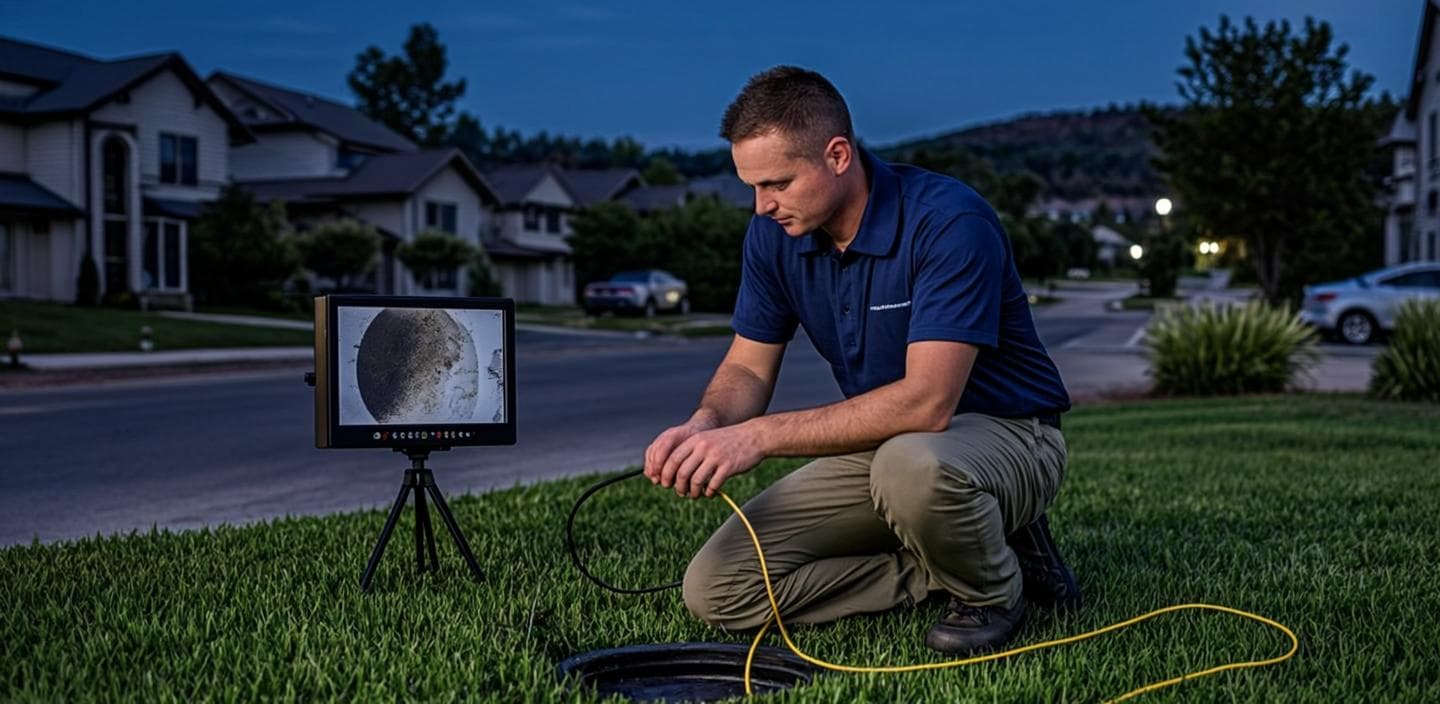
Leak detection specialist feeding a sewer inspection camera into a yard cleanout in Temecula, CA with live pipe footage on a monitor

Camera · Sonde · Hydrostatic Testing · Temecula, CA

Sewer Line Leak Detection in Temecula, CA

Gurgling toilets, drains that slow down together, a strip of grass that's suddenly too green, a sewer smell that comes and goes — those are the classic signatures of a lateral that's cracked, root-invaded or bellied under your yard. We put a camera on it, sonde-locate every defect to the inch, hydrostatically test the drains under your slab, and hand you the video — so the fix targets the actual break instead of a guess.

  • Camera + Sonde on Every Truck
  • You Watch the Footage Live
  • Licensed, Bonded & Insured

See It With Your Own Eyes

No black-box diagnosis. The camera feeds to a screen you can watch, and you leave the visit with the video file and a written report — evidence, not opinion.

Sonde-Located to the Inch

The camera head carries a radio transmitter we trace from the surface, so every crack, root ball and belly is marked with its exact position and depth before anyone talks about digging.

Under-Slab Drains Proven, Not Assumed

Cameras show the pipe walls; hydrostatic and isolation testing prove whether the drains beneath your slab actually hold water. Together they settle the 'is it under the house?' question.

Reports Built for Bidders & Escrow

Footage distance, depth, defect type, cause assessment and flat-rate repair options — one document your repair plumber, home inspector, adjuster or buyer's agent can actually use.

The Drain-Side Specialist

What Is Sewer Line Leak Detection?

Sewer line leak detection is the diagnostic specialty for the drain-waste side of your property — the main lateral that carries everything your fixtures flush out to the sewer main in the street, plus the branch drains that feed it. It's a fundamentally different investigation from the pressurized supply leaks covered on our slab, water line and underground pages. Supply lines are pressurized and announce failures loudly; sewer laterals are gravity systems that fail quietly, slowly and out of sight — which is why the symptoms creep in as 'drain things' nobody rushes to fix, and why the damage compounds underground for months before it surfaces.

A proper sewer investigation answers three questions with evidence: what condition is the pipe in (camera inspection), where exactly is the defect (sonde locating and depth mapping), and does the system actually hold water (hydrostatic and isolation testing). Most general plumbers answer none of the three — they clear the clog in front of them, leave, and see you again in six weeks when the same roots regrow through the same joint. We find the cause, show you the pipe, and tell you honestly whether the line needs cleaning, a sectional repair or a replacement plan.

Temecula makes this work genuinely local. Much of the valley's housing stock went in during the 1980s and 90s building booms — right around the era clay laterals gave way to modern PVC, and decades before today's mature trees grew their roots to full reach. Add hard water scale in older cast-iron under-slab drains, expansive clay soils that flex buried pipe every dry-to-wet season, and hillside lots in Redhawk, Wolf Creek and De Luz where laterals run long and deep, and you get a valley with its own distinct sewer failure patterns — patterns our team works every single day.

Clog or Line?

Is It Just a Clog — or Is the Sewer Line Itself Failing?

Every sewer investigation starts with the question most homeowners get wrong in one direction or the other: is this a blockage a cable machine can clear, or is the pipe itself cracked, invaded or sagging? Treating a structural problem as a clog buys months of false peace and a bigger repair bill; replacing a pipe that only needed a good jetting wastes thousands. Here's the split we run through before any machine goes near a drain.

Behaves Like a Clog — Often Just a Clog

  • One fixture misbehaves while everything else drains fine — the guest bath sink, one toilet, the kitchen line.
  • The slowdown started suddenly, often right after something went down the drain.
  • A plunger or one cable pull clears it, and it stays clear for months.
  • No odors in the yard, no soggy or extra-green patches, no gurgling in distant fixtures.
  • The cleanout outside drains freely once the blockage is pulled.
Book a drain cleaning visit

Suspect the Line Itself — Get It Camera'd

  • Multiple fixtures back up at once, lowest drains first — toilets and tubs gurgle together when the washing machine drains.
  • Backups repeat every few weeks even after professional cleanings — the blockage keeps coming back to the same place.
  • A sewer odor inside the house or over the yard that cleaning doesn't explain.
  • One strip of lawn is greener, spongier or faster-growing than the rest — or the ground sinks slightly along the line route.
  • Every drain in the house is sluggish and toilet water levels drift up or down between uses.
  • Pests: rats or drain flies that trace back to a broken lateral venting or leaking underground.
Get it camera'd — (951) 393-1867

The tell: Scope of the symptom. One fixture, one pattern, clears and stays clear — that's a clog, and a cleaning is the honest fix. Many fixtures moving together, the same spot backing up again and again, odors or yard symptoms — that's a pipe problem wearing a clog's clothing. A camera settles it in under an hour, without opening anything, and the footage means you never have to take anyone's word for it.

Before You Close Escrow

Buying in Temecula? Scope the Sewer Before You Sign.

A standard home inspection does not include the sewer lateral — the inspector checks the house, not the 50 to 100 feet of buried pipe between it and the street. Yet the lateral is one of the most expensive things a Temecula buyer can inherit: replacement projects commonly run $6,000–$12,000 and climb past $20,000 when driveways, patios and mature landscaping sit in the path. A pre-purchase camera scope costs a fraction of that and has a habit of paying for itself on the spot — buyers use our video reports to negotiate repairs or credits before closing, not to discover the problem during the first holiday dinner.

Temecula's inventory makes this especially worth doing. The valley's big building waves — Redhawk, Paloma del Sol, Wolf Creek, Harveston and the 1980s–90s tracts across the ZIP codes — mean a large share of homes sit right at or past the age where original clay laterals, cast-iron under-slab drains and first-generation PVC start showing their history. Homes with mature street trees or big backyard shade trees deserve a harder look: roots find lateral joints from remarkable distances. And rural pockets out toward De Luz, Fallbrook and Winchester sometimes carry Orangeburg or improvised pipe runs from the days before the trunk lines arrived.

Our escrow scopes are built for the transaction: we access through the cleanout or an exterior drain, record the full run to the city tap, sonde-mark any defects with surface position and depth, and deliver a video file plus a written summary — often the same day your contingency clock demands it. No digging, no water on, no drama; just the actual condition of the most expensive pipe you're about to own.

Book an escrow scope — (951) 393-1867

What the Scope Covers

  • Full-length video to the street connection — you keep the file
  • Root intrusion, cracks, offsets, bellies and channeling, tagged at footage distance
  • Sonde-located surface marks with depth for any defect found
  • Material and era identification — clay, cast iron, Orangeburg, PVC
  • Hydrostatic add-on to test whether under-slab drains hold water
  • Same-week written summary formatted for agents, inspectors and lenders

Drain-Side Symptoms

8 Signs Your Sewer Line Is Leaking, Cracked or Root-Invaded

Sewer laterals rarely fail all at once — they announce themselves in a sequence, and most homeowners see three or four of these before anyone connects the dots. Any one of these is worth a conversation; two or more together is a line that's telling you exactly where it hurts. The good news: every one of them can be confirmed on camera without touching a shovel.

Gurgling Drains & Toilets

A healthy drain is a quiet drain. Gurgles mean air is trapped where flowing water should be — usually a partial blockage or a cracked section pulling air through the fixture traps. When the toilet blips as the washing machine drains or the tub gurgles as the sink empties, the vent path or the line itself is compromised.

Multiple Fixtures Backing Up Together

One slow sink is a fixture problem; a toilet, a tub and a laundry line backing up in the same afternoon is a lateral problem. The blockage or break sits downstream of them all — and in a gravity system, the lowest fixtures feel it first. This is the classic 'main line' moment, and it deserves a camera, not just another cable run.

Sewer Odors Inside or Over the Yard

Sewer gas should vent through the roof, not through a crack under the slab or a split in the yard. A smell that comes and goes with weather or water use points to a break venting where it shouldn't, a dry or damaged trap, or a cleanout cap that's failed. Odor with no backup is the sneakiest early sign — the pipe is leaking before it's plugged.

One Suspiciously Green, Soggy Strip of Yard

A leaking lateral is an underground irrigation line for whatever's above it — and grass doesn't hide its gratitude. A strip that's greener, thicker or spongier than the lawn around it, especially in a straight path toward the street, is a leak feeding the soil. Temecula's clay soils hold that moisture and make the signature last.

Backups That Keep Coming Back

Roots don't die when they're cut — they regrow into the same joint, often thicker. If the line has needed clearing two or three times in the past couple of years, the cable has been treating a symptom while the cause waits underground. Each round of cutting scours the joint a little wider; the camera shows you what the cleanings keep running into.

Rats, Roaches or Drain Flies That Won't Quit

A broken lateral is an underground highway: rats follow sewer corridors, roaches ride the gaps, and drain flies breed in the sludge a cracked pipe leaves in the soil. Pest control treats the visitors; we find the door they're using. If an infestation traces toward bathrooms or the laundry wall, it's worth ruling out the pipe.

Everything Sluggish + Toilet Levels That Drift

When every drain in the house is slow at the same time — and toilet bowls refill to slightly different levels day to day — the system is telling you flow is restricted at the bottom or a crack is letting air and water escape. This whole-house pattern is the difference between 'a fixture issue' and 'the line,' and it usually precedes the first true backup.

Damp Slab, Depressed Ground or Sink-Like Spots

Under-slab drain leaks show up as warm damp spots on flooring, baseboard mold near laundry walls, or — outdoors — a shallow depression along the line route where leaking water is carrying soil away. Ground that's sinking toward a trench-shaped dip is a line losing soil support, and it's one of the calls we most want early.

Our Services

Every Leak Detection Service We Offer

Sewer investigation is one branch of the same specialty. The same licensed Temecula team, the same evidence-first approach and the same flat-rate, video-documented reporting cover every service below — so whether the leak turns out to be in the drain, the supply, the slab or the yard, the next step is already in familiar hands.

Slab Leak Detection & Repair

Pinpoint hot spots, damp floors & the sound of running water under your foundation.

  • Electronic & acoustic under-slab pinpointing
  • Hot-spot thermal mapping for hot water slab leaks
  • Repair vs. reroute options with upfront pricing
Get Leak Help

Main Water Line Leak Detection

Find leaks between your water meter and your home before they undermine driveways.

  • Meter-to-home line pressure testing
  • Leak verification with meter isolation tests
  • Documentation for your water district & insurer
Get Leak Help

Underground Leak Detection

Sonic, tracer-gas & pressure testing to locate buried pipe leaks without digging.

  • Ground microphone & leak correlation surveys
  • Safe tracer-gas pinpointing under hardscape
  • Surgical, minimal-dig verification
Get Leak Help

Emergency Leak Detection

24/7 rapid response when a leak is flooding your home or flooding your yard.

  • 24/7 live emergency dispatch
  • Priority response for active flooding
  • Fast locating so repairs start sooner
Get Leak Help

Sewer Line Leak Detection

Camera inspections & hydrostatic testing that reveal breaks, roots & bellies.

  • HD sewer camera inspection with locator
  • Hydrostatic & isolation testing under slabs
  • Video documentation of every finding
Get Leak Help

Commercial Leak Detection

Restaurants, retail, offices & multi-unit properties across the Temecula Valley.

  • Restaurants, retail, offices & HOAs
  • After-hours & low-disruption scheduling
  • Reports formatted for insurers & managers
Get Leak Help

Gas Line Leak Detection

Safety-first combustible gas detection for your home, yard & appliances.

  • Combustible gas detector surveys
  • Pressure testing for yard & house lines
  • Clear findings for licensed gas repair
Get Leak Help

Not sure which service fits your situation? Describe the symptoms when you call (951) 393-1867 — we'll dispatch the right detection method. Or explore all 8 services in detail.

Why Laterals Fail

What Breaks, Cracks and Blocks Sewer Lines in Temecula?

Sewer pipes fail for a short list of reasons, and nearly all of them are written into the age and material of the pipe itself. Knowing which failure you have is the difference between a $600 cleaning and a correctly scoped repair — and every item below is visible on camera. These are the six we find most on Temecula Valley properties.

Tree Roots Invading Clay & Old Joints

Clay laterals were the Southern California standard into the late 1980s, and their hub-and-gasket joints are root magnets — trees sense the moisture and nutrient vapor escaping the joint and send feeder roots straight in. Once inside, roots ball up, catch paper and grease, and hydraulic-wedge the joint wider every season. Mature landscaping in established neighborhoods like Redhawk, Paloma del Sol and central Temecula makes this the valley's #1 lateral failure.

Cast-Iron Under-Slab Drains Corroding & Channeling

Mid-century and 1970s–80s homes often ran cast iron for the drains beneath the slab. Decades of Temecula's hard water and constant flow corrode the bottom of the pipe into a rough, channel-shaped groove — walls so ragged they snag every solid that passes. The line 'works' while it slowly closes, which is why symptoms arrive as years of gradually worsening sluggishness rather than one dramatic backup.

Bellies — Pipe Runs That Sag and Hold Water

A belly is a sagging section where the pipe loses its grade and water pools instead of flowing. They come from improper bedding at installation, soil settlement, or ground movement — and they're common after amateur repairs that backfilled poorly. Standing water in the sag collects solids, breeds repeat clogs, and eventually scours out the pipe's own support. No amount of cleaning fixes a grade problem; the camera measures the standing water and the sonde marks its exact spot.

Orangeburg & Other Legacy Materials

Between roughly the 1950s and 1970s, some lines were run in 'Orangeburg' — a tar-and-fiber pipe that flattens, blisters and collapses under decades of load. Older rural pockets and pre-annexation properties out toward De Luz, Fallbrook and Winchester still carry it, along with brittle undocumented runs from before the trunk mains arrived. If your home's plumbing history is a mystery, the camera is the archaeology.

Grease, Wipes & Everyday Misuse

Kitchen grease coats pipe walls year after year until the channel narrows to a straw; 'flushable' wipes tangle into the roots already waiting at the joints. This cause matters because it disguises the others: a line blocked by grease and wipes gets cleared, behaves for a while, and the underlying crack or belly underneath stays undiagnosed. That's why we video-verify after every clearing.

Valley Ground Movement & Drought Cycles

Southwest Riverside County's expansive clays shrink away from buried pipe through long dry spells, then swell violently with the season's first heavy rains — flexing rigid pipe, offsetting joints and snapping brittle materials. Add minor seismic movement and nearby excavation or pool digging, and laterals develop offsets and cracks that never show up above ground until they've been leaking for a year.

How We Investigate

5 Ways We Find Sewer Leaks — Without Guessing or Digging

A sewer diagnosis should end with you knowing three things: what's wrong, exactly where it is, and what it will take to fix. Every method below feeds one of those answers, and together they let us hand you a marked-up, video-backed report instead of a hunch. All of it happens without opening a floor, a wall or a yard.

  1. HD Camera Inspection With Live View

    We feed a self-leveling high-definition camera through the cleanout — or an exterior drain if no cleanout exists — and travel the line to the street connection while you watch on screen. Roots, cracks, offsets, bellies, channeling, grease and collapsed sections all get identified and tagged at their footage distance from the access point.

  2. Sonde Locating & Depth Mapping

    The camera head carries a radio transmitter (a sonde) that we trace from the surface with a receiver. For any defect, we mark its exact position on the ground and record its depth. That's what turns 'you have roots somewhere' into 'you have roots 43 feet out, four feet deep, two feet off the patio edge' — the difference between a bid and a guess.

  3. Hydrostatic Testing of Under-Slab Drains

    When symptoms point beneath the house, we isolate the drain system, fill it with water to slab level, and watch the level for 15–30 minutes. A steady level means tight pipes; a falling level proves an under-slab drain leak. It's the test that separates a cracked lateral in the yard from a leaking cast-iron run under the floor — two very different repairs.

  4. Isolation & Section Testing

    A failing hydrostatic test raises the next question: which run? We plug and test sections one at a time — kitchen, laundry, bathrooms, the main run — until the leak is bracketed to a single segment. Under the slab, that can shrink a $15,000 mystery into a focused repair at one marked location.

  5. Smoke & Dye Testing for Mystery Odors

    Sewer smell with no backup is its own puzzle. Non-toxic smoke pushed through the drain system escapes at exactly the crack, failed fitting or dry trap that's venting gas; dye testing traces suspicious water paths. It's a fast, clean way to close odor complaints that have stumped everyone else — including the ones that started 'after the remodel.'

Your Options, In Order of Damage

Sewer Repair and Replacement Options, Explained Honestly

Not every bad sewer needs a new one — and not every good-looking one survives another winter. The camera and test results put you in one of four lanes, and each has an honest 'best for.' We quote every applicable path flat-rate, in writing, and we'll tell you plainly when a $600 answer is the right answer — and when it's a $9,000 problem wearing a $600 disguise.

Hydro-Jetting & Root Removal

Best for: Live roots or grease in a pipe that still tests sound.

High-pressure water cuts roots flush to the pipe wall and strips grease scale in one pass, and we video-verify the walls afterward. It's the right move when the structure is intact and the problem is what's growing or coating inside it. We'll tell you honestly how likely regrowth is — and whether a lining or repair would save you repeat cleanings.

Sectional Spot Repair

Best for: One bad section on a line that tests sound everywhere else.

When the camera shows a single failed segment — one offset joint, one cracked run, one root-crushed section — we excavate or access just that zone, cut out the failure and couple in new PVC, then video-verify the finished joint. Small trench, one marked location, done in a day in most cases. This is exactly what sonde mapping is for: the dig is inches from the defect, not a guess across the yard.

Full Lateral Replacement — Trenchless or Open Trench

Best for: Collapsed runs, multiple failures, bellies or disintegrating legacy pipe.

When the line is failing in several places, replacement is the honest math. Pipe bursting pulls new HDPE through the old path with minimal digging; CIPP lining installs a seamless pipe-within-a-pipe where the host pipe is still viable; open trench remains the choice for shallow runs, big grade corrections or HOA requirements. We price what your line actually qualifies for — and we won't sell trenchless to a line that can't host it.

Under-Slab Drain Repair & Reroutes

Best for: Cast-iron or under-slab drains that fail hydrostatic testing.

Confirmed under-slab leaks get their own decision tree: tunnel beneath the slab to the failed section, open small slab access points at marked locations, or abandon the failing run and reroute drains through walls or the attic where code and layout allow. Each has tradeoffs in cost, disruption and finishing work — we lay them out with the test evidence so the choice is yours, informed.

Costs, Honestly

What Does Sewer Leak Detection and Repair Cost in Temecula?

Sewer pricing swings more than any other plumbing category because the work ranges from 'flush a camera through a clean pipe' to 'burst 80 feet of collapsed clay under a driveway.' National data frames the bands: scopes run roughly $250–$500, repairs $1,300–$5,300+, and replacements commonly $6,000–$12,000 — with Southern California projects reaching $20,000 when access is hard. Here's how ours lands, flat-rate and in writing.

Camera Inspection & Diagnosis

$150–$450

Flat rate — video included

Our sewer inspection visit runs in the same flat band as all our detection work — under the national $250–$500 scope averages, with the video file and written report included rather than upsold. The fee is credited toward any repair we perform.

Jetting, Roots & Spot Repairs

≈$650–$2,500

By access & footage depth

Hydro-jetting and root removal sit at the lower end; sectional dig-and-replace on a marked spot runs mid-band. Because the defect is sonde-located first, the excavation is measured in feet, not hours of exploratory digging billed by the surprise.

Lateral Replacement

≈$6,000–$12,000+

Trenchless or open trench

Regional trenchless work (bursting or CIPP) typically lands $60–$250 per foot; open trench runs $80–$300+ per foot once driveway, patio and landscape restoration is counted. Deep runs, hard access and legacy materials push SoCal projects past $20,000 — which is exactly why we map and quote before committing.
Who Pays: Laterals, Mains, Insurance & the District

Sewer money questions start with ownership. The district's main lives under the street; the lateral that connects your home to it — usually its entire length, per standard Riverside County municipal practice — is the homeowner's responsibility. That's why a backup caused by your lateral is your repair and your claim, while a backup caused by the district's main may be theirs: documentation is what draws that line, and a dated video report showing exactly where the failure sits is the evidence that settles it. Insurance follows its own rules: sudden, accidental discharge is generally covered under standard policies, while gradual seepage from a line that's been leaking for months is where claims get disputed — and many carriers treat the pipe itself as maintenance, with optional sewer/water backup endorsements covering the damage side. Two practical moves: check whether your policy carries a backup endorsement (many Temecula homeowners added one after the 2023 storms), and keep every invoice and video from our visit — it anchors 'sudden' versus 'gradual' and supports any claim you file. For water-supply bill relief, Rancho Water's leak adjustment still applies to documented supply leaks; sewer-side losses ride on your policy and documentation instead.

Get the documentation that settles the claim

The Escalation Timeline

What a Failing Lateral Does While You 'Wait and See'

Sewer problems don't pause — they compound on a schedule measured in seasons, not hours like a burst supply line, but the endgame is more expensive because the damage is underground and invisible. Here's the same progression we watch play out on valley properties when early camera findings get shelved instead of scheduled.

Season one: roots and grease thicken

A hairline crack or a first root intrusion narrows flow a little more each month. Every backup scours the joint wider, every greasy rinse coats it further, and the line that cleared easily now needs more machine time each visit. The repair price hasn't moved much — but the clock has.

Season two: the belly deepens, the channel closes

Standing water in a sag keeps softening the bedding beneath it, so the belly grows and holds more water; a channeling cast-iron run closes toward a straw. Cleanings now recover less flow for more effort, and 'it's backing up again' becomes a household routine instead of an event.

Then: waste starts leaving the pipe

Cracked sections and failed joints begin leaking gray water into the soil — feeding that green strip of lawn, hollowing voids under patios and driveways, contaminating soil near the foundation, and drawing roots, rats and flies. What was a pipe repair now includes hardscape, soil and mitigation scopes.

Finally: collapse — and the no-dig window closes

A run that let go can't host a liner and often can't host a bursting cable. The fix becomes emergency excavation: the driveway cut, the patio lifted, the landscape rebuilt, on an emergency schedule at emergency prices. The camera visit that would have caught this at 'root ball at 40 feet' costs a few hundred dollars; the collapse costs five figures and a disrupted month.

Why Temecula Calls Us

Sewer Diagnosis Backed by Video, Not a Hunch

Sewer work is where the plumbing industry's worst habits live: clean the clog, take the money, see you in six weeks. We run the opposite discipline — camera the line, prove the cause, mark the location, test the system, and show you the footage before we talk about any repair. When we say the line has a belly at 43 feet, you'll have watched it happen on the screen and you'll hold the video file. That's also why our repair quotes hold: they're built from measurements, not from what the digging turned up after the price was already agreed.

The local edge is real, too. We work the Rancho California Water District collection area — Temecula, Murrieta and Wildomar — every day, so we know which neighborhoods went in on clay laterals, which tracts ran cast-iron under-slab drains, which hillside streets in Redhawk and Wolf Creek carry deep, long laterals, and what the big-lot and grove properties out toward Menifee, Winchester, De Luz and Fallbrook tend to hide. That map of the valley's pipes is why our first camera pass usually finds the story the last two cleanings missed.

Call Now — (951) 393-1867
  • You watch the footage live — and keep the video file

  • Sonde-located defects with depth, before anyone prices a dig

  • Hydrostatic & isolation testing prove under-slab drains

  • Flat-rate options in writing — cleaning, spot repair or replacement

Related Services

From Diagnosis to Done — Services That Finish the Job

Sewer findings often connect to the rest of the property's water story: the under-slab drains that share the slab with supply lines, the buried runs in the yard, the emergency that can't wait. These are the sibling services that pair most often with a sewer diagnosis — same team, same evidence-first approach, same reporting.

Valley-Wide Coverage

Sewer Line Leak Detection Across the Temecula Valley

From the tract laterals of central Temecula to the long rural runs of Menifee, Winchester and Fallbrook, we camera, locate and test sewer lines across the whole valley every week. Our crews know the districts, the soil and the pipe eras on your street — which is why the diagnosis lands the first time.

Sewer inspection coverage across the Temecula Valley

Also serving: Paseo del Sol, Vail Ranch, Morgan Hill, Temecula Creek, Chardonnay Hills, Crowne Hill, Old Town Temecula, Temecula Wine Country, De Luz, La Cresta, Lake Elsinore, Canyon Lake, Temescal Valley and more. Not on the list? Call (951) 393-1867 — if you're nearby, we'll find a way to help.

Sewer Line FAQs

Questions? Let's clear things up.

Straight answers about sewer lines in Temecula — clog or failing line, camera vs. hydrostatic testing, lateral responsibility, trenchless costs and escrow scopes.

Have a different question?

Describe the drain symptoms — a technician will walk you through it.

Ask Our Team

Scope of the symptom is the tell. One fixture acting up on its own, clearing with a plunger and staying clear, is almost always a clog — a cleaning is the honest fix. Multiple fixtures backing up at once (lowest drains first), gurgling in one fixture when another drains, backups repeating every few weeks after professional cleanings, sewer odors, or a soggy green strip in the yard all point at the pipe itself. A camera inspection settles it in about an hour: you'll watch the inside of the line on screen and see exactly whether the problem is a blockage that can be cleared or a crack, root invasion or belly that needs a repair plan.

Slow Drains, Gurgles, Odors?

Get Eyes on Your Sewer Line — Before It Decides for You.

One call books a camera inspection with sonde locating and video you keep. We'll show you the pipe, prove the cause, test the system and quote every honest option flat-rate — before anything is opened.

Call Now(951) 393-1867